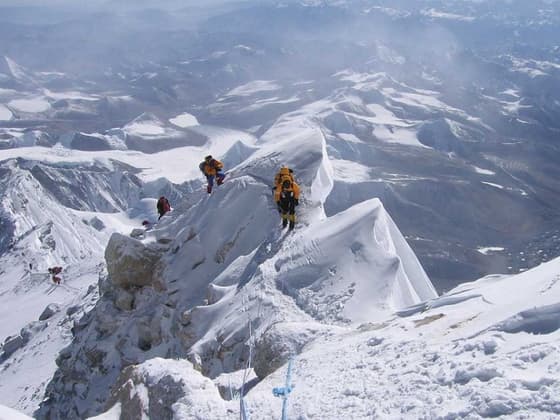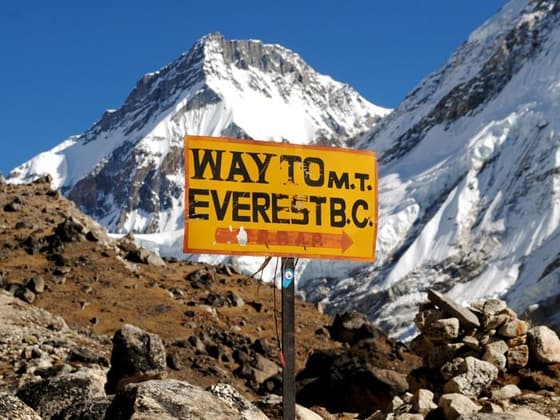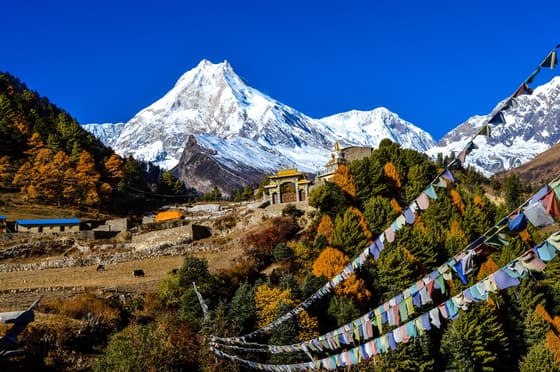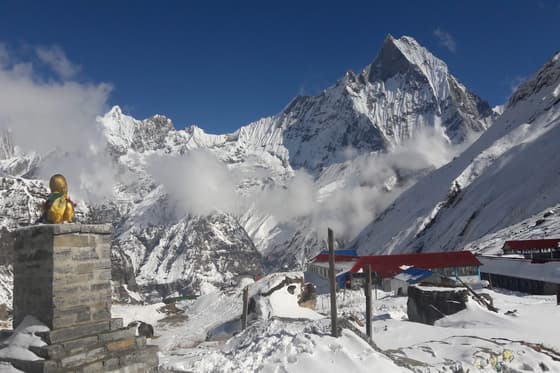

The highest mountains in the world are the fourteen peaks above 8,000 m, all of them in Asia. Mount Everest is the highest at 8,849 m, on the border of Nepal and China. K2 is second at 8,611 m. Eight of the fourteen stand wholly or partly in Nepal, which is why so many expeditions start in Kathmandu.
What are the fourteen highest mountains?
Climbers call them the eight-thousanders. Here they are in order.
| # | Mountain | Height | Country |
|---|---|---|---|
| 1 | Everest | 8,849 m | Nepal / China |
| 2 | K2 | 8,611 m | Pakistan / China |
| 3 | Kangchenjunga | 8,586 m | Nepal / India |
| 4 | Lhotse | 8,516 m | Nepal / China |
| 5 | Makalu | 8,485 m | Nepal / China |
| 6 | Cho Oyu | 8,188 m | Nepal / China |
| 7 | Dhaulagiri I | 8,167 m | Nepal |
| 8 | Manaslu | 8,163 m | Nepal |
| 9 | Nanga Parbat | 8,126 m | Pakistan |
| 10 | Annapurna I | 8,091 m | Nepal |
| 11 | Gasherbrum I | 8,080 m | Pakistan / China |
| 12 | Broad Peak | 8,051 m | Pakistan / China |
| 13 | Gasherbrum II | 8,034 m | Pakistan / China |
| 14 | Shishapangma | 8,027 m | China |
No other mountain on earth comes close. The highest peak outside Asia is Aconcagua in Argentina, roughly 2,000 m lower than Everest.
How many of them are in Nepal?
Eight: Everest, Kangchenjunga, Lhotse, Makalu, Cho Oyu, Dhaulagiri, Manaslu and Annapurna I. Five more are in Pakistan, and Shishapangma is the only one entirely inside China.
That is why Nepal is the base for so much of world mountaineering. Everest, Lhotse, Makalu and Cho Oyu are all in the east of the country. Dhaulagiri, Annapurna and Manaslu run across the centre. Kangchenjunga sits on the Indian border in the far east.
Nepal also holds the practical side of it: the permits, the guides, the Sherpa climbing teams and the flights. An expedition to the Nepal side of Everest is organised from Kathmandu, as ours is: see our Everest expedition page, a 60-day climb.
Which of the highest mountains can you actually reach?
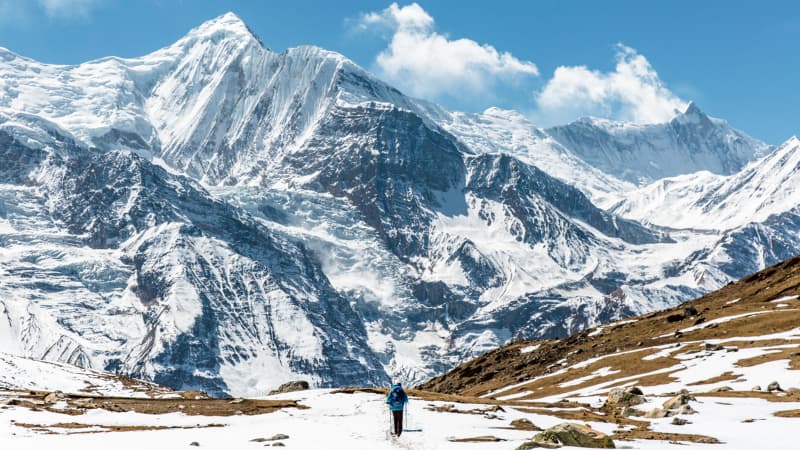
You do not have to climb to stand at the foot of them. Several of the fourteen have walking routes to their base, on ordinary teahouse trails.
| Mountain | How close you get | Trip | Days |
|---|---|---|---|
| Everest | Base Camp and Kala Patthar, 5,545 m | Everest Base Camp trek | 14 days |
| Manaslu | Base camp day hike from Sama Gaon | Manaslu Circuit trek | 15 days |
| Annapurna I | Annapurna Base Camp, 4,130 m | Annapurna Base Camp trek | 9 days |
| Everest and Lhotse | Seen from the air in one hour | Everest scenic flight | 2 hours |
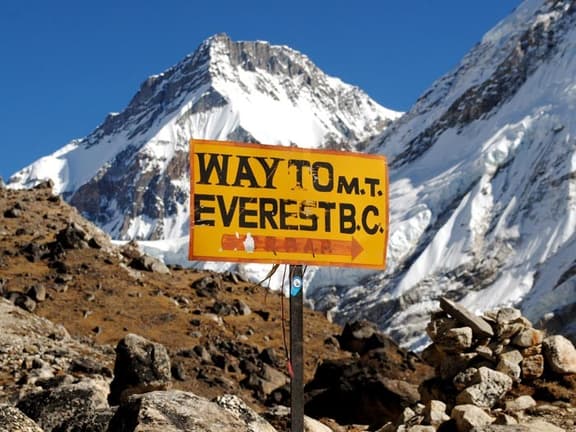
The Everest Base Camp trek is the best known. It reaches 5,545 m at Kala Patthar, which is the viewpoint, not the summit. The highest point you sleep at is lower.
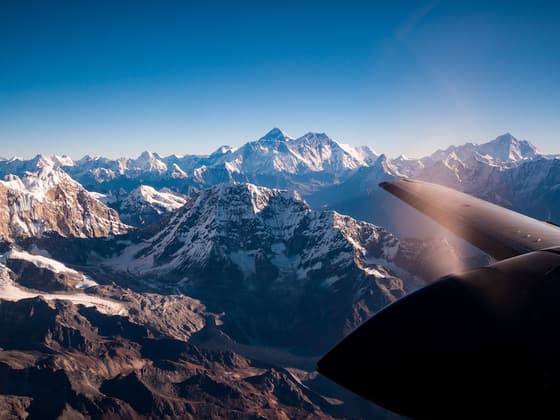
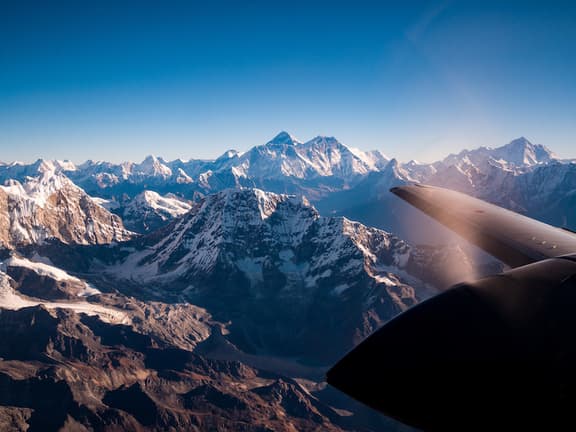
The scenic flight is the other extreme. It takes about an hour, flies along the range at the height of the peaks, and needs no fitness at all. Everyone gets a window seat.
Can you see them from Kathmandu?
Part of the range, on a clear morning, from the rim of the valley rather than from the city. Nagarkot and Chandragiri both look north over a long stretch of Himalaya, and winter gives the cleanest air of the year.
What you will not reliably pick out from there is Everest itself. It is far to the east and often lost among nearer peaks. The dependable way to see it from Kathmandu is the one-hour scenic flight, which flies along the range at the height of the summits and gives everyone a window seat.
Why are all of them in Asia?
Because of a collision that is still happening. The Indian plate is pushing north into the Eurasian plate, and the crust between them has nowhere to go but up.
That collision built the Himalaya and the Karakoram, and it has not stopped. The range is still rising by a few millimetres a year, though erosion takes some of it back.
Nothing anywhere else on earth has had the same forces for the same length of time. The Andes, the Alps and the Rockies are all products of smaller collisions. It is why the gap between the fourteenth highest mountain and the fifteenth is so large.
Is Everest really the biggest mountain?
Highest, yes. Biggest depends on where you start measuring.
- Highest above sea level: Everest, 8,849 m. This is the usual meaning.
- Tallest from base to summit: Mauna Kea in Hawaii, which rises about 10,000 m from the sea floor, though only about 4,200 m of it is above water.
- Furthest point from the centre of the earth: Chimborazo in Ecuador, because the planet bulges at the equator.
All three are true at once. They answer different questions, which is why the same quiz question gets three different answers.
What is the death zone?
Everything above 8,000 m, which is to say the summits of all fourteen. At that height there is roughly a third of the oxygen available at sea level, and the body cannot acclimatise. It is dying, slowly, for as long as it stays there.
That is the real reason these mountains are dangerous. Climbers move through the zone as fast as they safely can, usually with bottled oxygen. Weather that would be an inconvenience lower down becomes fatal.
Reinhold Messner was the first person to climb all fourteen, finishing in 1986, and he did it without bottled oxygen. Fewer than fifty people have completed the set in the forty years since.
Why do the heights change?
Because measuring a mountain is harder than it sounds. Everest's official height was revised in 2020, when Nepal and China announced a joint survey figure of 8,848.86 m, usually rounded to 8,849 m. The older figure of 8,848 m is still printed in many places, including on some of our own pages.
Three things make it difficult. Snow depth at the summit changes. The plates are still moving, so the rock is slowly rising. And height has to be measured from sea level, which has to be modelled rather than seen.
For a trekker none of this matters. For a quiz, use 8,849 m.
Where do expeditions to these mountains start?
In three cities, and which one depends on the mountain.
Kathmandu is the base for the eight in Nepal. Permits, liaison officers, climbing Sherpas and the flights to the trailheads are all arranged here. Our own Everest expedition runs this way, 60 days from Kathmandu.
Islamabad and then Skardu serve the five in Pakistan, including K2. The approach is longer and the infrastructure thinner than in Nepal.
Lhasa is the base for Shishapangma and for the northern side of Everest, which is in Tibet rather than Nepal.
The seasons differ too. The Nepal eight-thousanders are mostly climbed in spring, before the monsoon, with a smaller autumn season. The Karakoram peaks are climbed in summer, because their weather works the other way round.
Is the highest mountain the hardest?
No, and this surprises people. Everest is the highest, but K2 and Annapurna I both kill a far higher share of those who attempt them. K2 is steeper, more technical and has no easy route. Annapurna I is avalanche-prone.
Everest's difficulty is altitude, weather and crowding rather than technical climbing. That is a real distinction, and it is worth understanding before anyone calls one mountain easier than another.
For most visitors, the useful comparison is not between summits. It is between a trek that reaches 4,130 m and one that reaches 5,545 m, and both are a long way below 8,000 m.
The official rules, permits and royalties for climbing in Nepal are published by the Nepal Tourism Board, and national park entry is handled by the Department of National Parks and Wildlife Conservation.
Frequently asked questions
What is the highest mountain in the world?
Mount Everest, at 8,849 m, on the border of Nepal and China. The height comes from a joint Nepali and Chinese survey announced in 2020, which measured it at 8,848.86 m. Older sources often say 8,848 m.
How many mountains are above 8,000 m?
Fourteen, all in Asia, across the Himalaya and the Karakoram. Climbers call them the eight-thousanders. Eight stand wholly or partly in Nepal, five in Pakistan, and Shishapangma is entirely inside China.
Is K2 harder to climb than Everest?
By most measures, yes. K2 is 8,611 m, lower than Everest, but it is steeper, more technical and has no straightforward route. A far higher share of climbers who attempt K2 do not come back. Everest's main difficulties are altitude, weather and crowding.
Can I walk to Everest Base Camp without climbing experience?
Yes. The 14-day Everest Base Camp trek is a walking route on teahouse trails, reaching 5,545 m at Kala Patthar. It needs no ropes or technical skill, but it does need fitness and proper acclimatisation days, which a good itinerary builds in.
Which eight-thousanders are in Nepal?
Everest, Kangchenjunga, Lhotse, Makalu, Cho Oyu, Dhaulagiri I, Manaslu and Annapurna I. Several sit on a border, with Everest, Lhotse, Makalu and Cho Oyu shared with China and Kangchenjunga shared with India.