
Photo: Bijay Chaurasia, CC BY-SA 4.0, via Wikimedia Commons. Down jackets, sleeping bags and trekking shoes outside a shop in Thamel, Kathmandu, February 2024. Cropped. It isn't an HSJ photo or HSJ's equipment.
This is an operations-based what-to-expect walkthrough, not a field report. We don't have notes from a real preparation day. Everything below follows what HSJ's 15-day Manaslu Circuit itinerary and trip page say happens before departure. It doesn't describe a real guide, guest or decision. For permits and current trail access, read our updated Manaslu Circuit for beginners guide.
The day before a Manaslu departure looks quiet from the outside. On HSJ's itinerary, Day 2 is a guided tour of Kathmandu, with the afternoon free for last-minute gear shopping in Thamel. Underneath that, the itinerary has one short line: permits are checked and gear is finalised, ready for an early start. This is a walkthrough of what goes into that line.
It starts the evening before
On Day 1, an HSJ representative meets you at the airport and takes you to the Himalayan Suite Hotel. In the evening, your guide holds the trek briefing, covering permits, gear, the daily schedule and what to expect on the route. The preparation day builds on that conversation. Anything the briefing raised, such as a missing item, a medication question or a worry about the pass, is something to sort out before the bus leaves.
The route
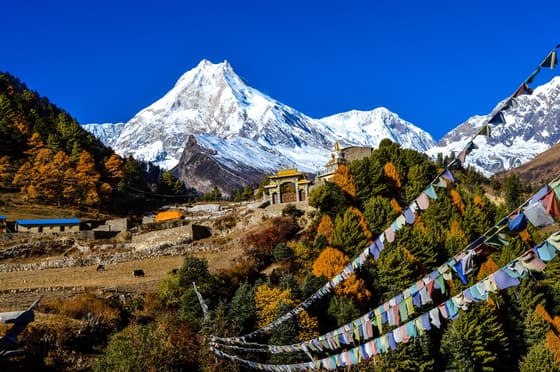
A guide preparing for Manaslu is preparing for a long, one-way line on a map. HSJ's itinerary drives west on Day 3 to Machha Khola, where the road ends. From there the trail follows the Budhi Gandaki up the valley. It reaches the restricted-area checkpoint at Jagat on Day 4, passes the Tsum Valley junction at Lokpa and the conservation-area checkpoint at Namrung, and has the acclimatisation day at Sama Gaon and the pass day from Dharamshala. It leaves the restricted area at Dharapani.
Checking the route means more than reading that list. In a season like this one, with floods in the lower valley and snow higher up, it can mean checking the latest advisories and local reports on the road to Machha Khola and the state of the lower trail. Those are current conditions. This article doesn't report on them, and the beginner guide has the dated updates.
If a trip includes Tsum Valley, that's a separate check. Tsum's status has changed several times this autumn, and news about the main circuit doesn't tell you about Tsum.
The documents
Manaslu is a restricted area, so paperwork has to be right. HSJ arranges three permits for this trip: the Manaslu Restricted Area Permit, the Manaslu Conservation Area Permit and the Annapurna Conservation Area Permit. HSJ's booking terms say restricted-area permits are applied for at least seven days ahead, so by the preparation day the permits should already exist. What's left is checking that they match the people, the dates and the passports.
From your side, that usually means having these within reach:
your passport, with your Nepal visa,
your travel insurance details, including the emergency number. HSJ requires cover for emergency helicopter evacuation.
any medical information your guide should know about.
Permits are checked again on the trail, starting at the police post at Jagat on Day 4.
The equipment
The afternoon in Thamel exists for a reason. HSJ's gear list for Manaslu includes:
a four-season sleeping bag rated to −15°C (HSJ provides one if needed),
broken-in waterproof boots,
a down or insulated jacket and a layering system,
gaiters and trekking poles,
a head torch with spare batteries,
a way to treat water,
warm gloves and a windproof shell for the pass.
Packing also means splitting your things. HSJ's trip has one porter for every two trekkers, carrying up to 15 kg per porter. So you're sharing a load limit with another person, and whatever you need during the day goes in your own day pack. Anything you don't need on the trail can stay in storage at the hotel.
The guide's kit includes a first aid kit with a pulse oximeter, which HSJ's page says is used to monitor trekkers' health on the trail. If you take any regular medication, the preparation day is the time to tell your guide.
Communications and money
HSJ's page is plain about this. Mobile signal is patchy across the Manaslu region. Wi-Fi is available at most teahouses for a fee, but it's slow above Namrung and intermittent at Dharamshala and Bimthang. Charging is limited and costs extra, so a power bank matters.
Before departure, it helps to tell people at home that you may be out of contact for days at a time, and to make sure your guide and HSJ's Kathmandu office have your emergency contact.
Money is simple. HSJ's page says there are no ATMs or money exchanges between Machha Khola and Bimthang. Lunches and dinners on the trail aren't included in the package, and showers, charging and drinks cost extra. You change money into rupees in Kathmandu, in small notes.
The early start
By the end of Day 2, if the preparation has done its job, the next morning is just a matter of getting on the bus. The itinerary gives no time, only an early departure for a long drive into Gorkha.
None of this guarantees anything about weather, the pass or how you'll feel at altitude. Preparation can't do that. What it can do is make sure the predictable things are already taken care of before you start.
For the full itinerary and inclusions, see HSJ's Manaslu Circuit Trek page. If you're travelling alone, read Arriving Solo, Meeting Your Guide.
Reviewed by Amrit Sapkota, Himalayan Social Journey