
Photo: Bijay Chaurasia, CC BY-SA 4.0, via Wikimedia Commons. Patan Durbar Square, one of the seven stops, at midday.
This is a what-to-expect story, not a trip report. It describes how a full day on HSJ's seven-site Kathmandu Valley tour is put together, following the current itinerary, with a focus on the parts between the monuments. It doesn't describe any particular guest or guide. Timings depend on traffic, crowds and your own pace.
Most of what you'll read about the seven UNESCO sites of the Kathmandu Valley is about the sites themselves: the stupas, the palaces, the pagodas. This piece is about the rest of the day. That means getting in and out of the vehicle, the steps, the gate counters and the breaks in between, and how to keep some attention for the seventh stop as well as the first.
The pickup and the first drive
On the Kathmandu 7 UNESCO Heritage Sites Day Tour, you choose a start time of 8:00, 9:00, 10:00 or 11:00 am, and the day begins at your hotel. Your guide meets you there, and you set off in a car, van or Hiace, depending on the size of your group.
The first drive, to Swayambhunath, takes about 15 to 20 minutes. Your guide uses it to go through the day's plan and give you some background on Kathmandu. This is the best moment to say what matters to you. If you want longer somewhere, need to take stairs slowly, or want to keep the photo stops short, say so now. The order of the sites is flexible, so it's easier to adjust at the start than halfway through.
Seven arrivals, seven departures
The day has a rhythm you'll soon recognise. The vehicle pulls up as close as it can, and you get out and walk the last part. Your guide helps you buy the ticket at the counter, paid in cash. You go in, explore, and come back out to the vehicle. Then there's a short drive, and the same thing happens again. Seven times.
That rhythm is useful once you notice it. Keep your cash and passport somewhere you can reach easily, not at the bottom of a bag. Carry your water bottle each time you get out. Before each drive, ask where the next stop is and roughly how long it will take. The legs are short (about 15 minutes to Kathmandu Durbar Square, 20 to 25 minutes on to Patan, about 15 minutes from Changu Narayan to Bhaktapur), so the time in the vehicle is for resting, not for catching up on sleep.
For what each ticket costs by passport, see our Kathmandu UNESCO entry fees guide.
Steps, shoes and slowing down
The tour is graded easy, but it isn't flat. The first stop is the steepest. At Swayambhunath you climb the stairs to the top for the view over the valley, often with the resident monkeys around you. Take it at a speed you could keep up all day, not the speed you'd manage in the first hour. Pashupatinath has steps of its own later on.
Your shoes will come off and go back on more than once, because some temple areas ask you to remove them. Comfortable shoes that are quick to slip off and on save time. Dress modestly, with shoulders and knees covered, because several of these places are active places of worship. At Pashupatinath, non-Hindu visitors stay in the outer areas, so your guide will show you where you can go.
The middle of the day
Kathmandu Durbar Square and Patan come one after another: Hanuman Dhoka's palace courtyards and Kumari Ghar, then Patan's Newari temples and the Patan Museum. Two royal squares in a row can start to blur together. One way to keep them apart is to give each one a single question and ask your guide just that, rather than trying to take in everything.
After Patan, the drive out to Changu Narayan on its hilltop is a natural break. The city falls away, and the temple's stone and wood carvings reward a slower look. Bhaktapur is about 15 minutes further on, with the 55-Window Palace, the Golden Gate and Nyatapola. Many people find their energy drops here. It's fine to sit on a step for a few minutes before you go on.
Lunch isn't part of the tour, so ask your guide early in the day where and when you might stop for food. Don't leave it until you're already hungry.
The long drive and the last two stops
From Bhaktapur back to Pashupatinath is the longest leg of the day, about 35 to 45 minutes. It's worth using to drink some water and decide how much energy you want to keep for the end. At Pashupatinath you walk along the Bagmati River, where Hindu ceremonies, including cremations, take place. Keep a respectful distance, and ask your guide before you photograph anything.
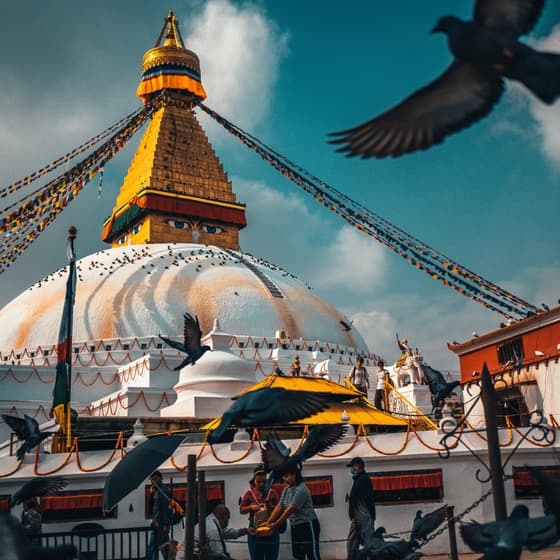
Boudhanath, about 10 to 15 minutes away, is the last stop. Walking around the stupa clockwise, past the prayer flags, monasteries and shops, makes a calm way to finish. After that, the vehicle takes you back to your hotel. In all, the day lasts roughly seven hours, including pickup and drop-off.
Keeping your attention for the whole day
Choose your highlights at the start. Pick one or two sites where you'll want extra time, and tell your guide during the first drive.
Keep the basics within reach. Have cash, your passport, water and sun protection ready for every stop.
Rest between sites, not in the middle of them. Use the drives to rest so you have more energy at each site.
Say if it's too much. The tour can also be split over two days. Ask about this when you book if a single long day doesn't suit you.
To see the itinerary and options, visit the Kathmandu 7 UNESCO Heritage Sites Day Tour.
Reviewed by Amrit Sapkota, Himalayan Social Journey