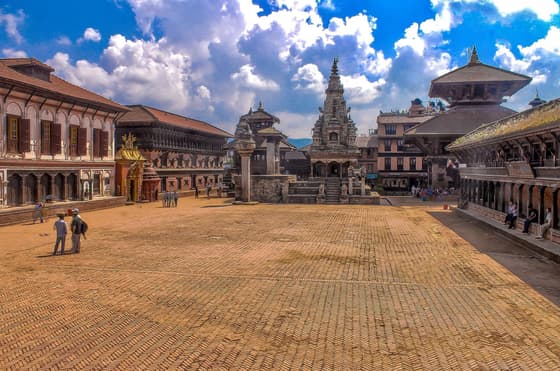



Photo: Gerd Eichmann, CC BY-SA 4.0, via Wikimedia Commons. Rows of clay pots drying in Pottery Square, Bhaktapur, with the square's shrine and houses behind.
This is a what-to-expect story, not a trip report. It describes what a stop at Bhaktapur's Pottery Square can be like on a walking tour, and how to be a good visitor in a place where people live and work. It doesn't describe any particular potter or household. What you see on the day depends on the season, the weather and the work going on.
By the time you reach Pottery Square on a Bhaktapur walk, you've already seen the palace and Nyatapola. It would be easy to treat the potters' square as one more stop, take a photo of the pots and move on. This piece is about not doing that, about giving the square ten or fifteen unhurried minutes and seeing it as what it is, a place where people work.
Arriving from Taumadhi
On HSJ's Bhaktapur Durbar Square Tour, Pottery Square comes after Nyatapola Temple, in the middle part of the day. It's a short walk down from Taumadhi Square through the brick lanes. The lane opens into a square, and the first thing you may notice is the floor. It isn't empty paving. Depending on the day, it can be covered in clay pots set out in rows to dry, some still dark and damp, some already pale, along with heaps of straw and the tools of the trade.
Before you take out your phone, stop at the edge for a moment and look at how the square is being used: where the pots are, where people are moving, where there's a path through.
A working place first
Bhaktapur is a lived-in city, and Pottery Square, also called Talako Tol, is one of the places where that's easiest to see. Pots are shaped on wheels and left in the open to dry. The square's paving is a workspace and a drying floor as well as a public square.
So the order matters. The work comes first and the visit second. Every row of drying pots is somebody's day's work. A bag swung too close or a careless step backwards for a better angle can undo it. If the only path is between the rows, wait or go round. Never step over or across the pots.
What you might see
It's worth staying flexible here, because no visit is the same. On some days a wheel may be turning in a doorway or under a shelter. On others the work may be mostly drying, stacking or moving finished pieces, or there may be little going on at all because of a festival, the weather or the time of day. Your guide can tell you what's usual in that season, but nobody can schedule a potter's work around a tour.
Whatever is going on, you can still take in the look of the place. The clay colours change as the pots dry. Small shops around the edge sell finished pieces, and the square has a shrine at its centre. In the middle of the day the light falls flat across the rows.
How to be a good guest here
Ask before you photograph a person. The pots and the square are one thing. Someone's face, hands or home are another. A gesture toward your camera and a nod or a shake of the head is enough. If they say no, or look away, put the camera down.
Keep your distance from anyone working. Stand back from wheels and kilns. Don't lean in for a close-up while someone is concentrating.
Don't touch work in progress. Unfired clay marks and breaks easily.
Doorways are private. An open door is not an invitation. Stay out of courtyards and homes unless someone clearly asks you in, and even then your guide can help you judge.
If you want a souvenir, buy it from the shops. Finished pottery is for sale around the square. That's a better way to support the craft than photographing someone's work for free.
Slowing down
Once you've found a spot out of the way, maybe at the edge of the square or near the shrine if it isn't in use, try simply staying for a while. Don't explain anything to yourself yet. Watch how people cross the square, how the rows are laid out and moved, and how the place works as a neighbourhood around the visitors.
If you have questions, ask your guide quietly rather than calling out to people at work. The guide can tell you about Bhaktapur's pottery tradition, the different stages you might be looking at, and what's appropriate to ask. If a potter chooses to talk to you or show you something, that's their choice. Don't expect it or ask for it.
A clay cup, and moving on
Bhaktapur is known for Juju Dhau, a thick buffalo-milk yoghurt traditionally served in a clay cup. It's a good reminder that the pottery here is part of everyday life, not just decoration. If you'd like to try it, your guide can point you to a place nearby. Meals and snacks aren't included on the HSJ tour, so bring some cash.
When you leave, take the same route out that you came in, around the rows rather than through them. The square will look much as it did when you arrived, and that's the point.
Before you go
Cash for the Bhaktapur entry ticket, which isn't included on HSJ tours, and for snacks or a souvenir
Comfortable shoes for brick lanes and uneven paving
Time: if you can, plan ten or fifteen unhurried minutes here
For the ticket price, the four-square route, museums and how long to stay, read our Bhaktapur Durbar Square guide.
Reviewed by Amrit Sapkota, Himalayan Social Journey