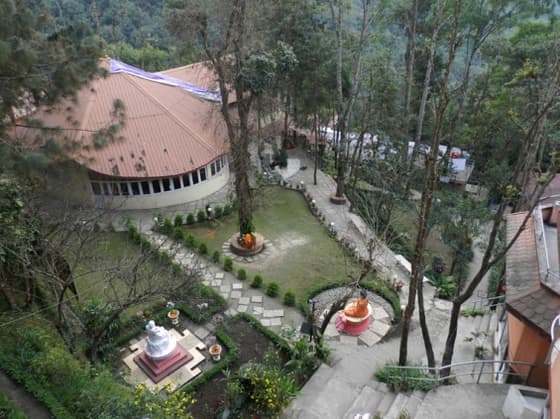


Photo: Deepak-nsk, CC0 1.0 (public domain dedication), via Wikimedia Commons. The Osho statue at Osho Tapoban commune, near Kathmandu. Cropped to landscape.
This is a what-to-expect guide, not a personal account. It describes how a first overnight at Osho Tapoban usually runs on Himalayan Social Journey's package. Session times are set by the commune and can vary, so treat the timings below as a typical rhythm rather than a fixed timetable.
Osho Tapoban is a meditation commune in the Nagarjun forest, on the north-western edge of the Kathmandu Valley, about 30–45 minutes by road from Thamel. A night here isn't a hotel stay. You join the daily rhythm of a living community: meditation, satsang, shared vegetarian meals and an early start. If you've never been, here is what the first evening and the following morning can look like.
The drive out: leaving the city behind
The overnight starts in the afternoon, which leaves your morning in Kathmandu free. Our driver picks you up for the drive via Balaju, then about 5 km up a forested road into the Nagarjun forest. The road climbs away from the traffic, and pine forest closes in on both sides. Return transport is part of the package, so you don't have to work out the route or the gate yourself.
Pack light: loose, plain-coloured clothes you can move in, a warm layer for the cooler forest evenings and mornings, basic toiletries, a water bottle and a torch for paths after dark. Tapoban is alcohol-free, and the commune isn't suitable for children under 12.
Arriving: check-in and time to settle
When you arrive, you check in to your room, a simple, clean twin-sharing room facing the forest. If you asked for a single-gender room or for not sharing when you booked, we'll have put that request to the commune.
No session starts the moment you put your bag down. There's time to walk the grounds before anything is asked of you. The commune is self-contained, with accommodation, meditation halls, a communal kitchen, gardens and walking paths through the forest, all within a short walk. Among the gardens you'll find a white statue of Osho, the teacher whose methods the commune follows.
This is a good time to find the meditation garden, work out where the meditation hall is, and let the pace of the afternoon slow down. Some sessions ask for silence, and the dress code and photography rules inside the hall are enforced. If you're unsure about anything, ask on arrival.
Evening: meditation and satsang
As the light changes in the forest, the commune gathers for evening meditation. Which one depends on the schedule. It may be Kundalini Meditation, an hour-long active session of shaking, dancing and then stillness, or a quieter sitting practice.
You don't need any experience, and you don't need to know anything about Osho. The sessions are guided, so you'll be shown what to do. Satsang follows: a communal gathering for reflection and discourse. You're there to take part on your own terms. Nobody expects you to arrive believing anything.
Dinner and the night
Dinner is vegetarian, freshly prepared in the commune kitchen and eaten together. Meals at Tapoban are simple, and there's no bar. After dinner the evening is quiet. Bring your torch if you plan to walk between buildings, because forest paths aren't always well lit. You spend the night at Tapoban, and an early night is sensible because the next day starts before dawn.
In winter (December to February) the rooms are simple and the mornings cold, so keep your warm layer close.
Before dawn: Dynamic Meditation
The morning begins with Dynamic Meditation, Osho's signature morning practice and the main reason we recommend staying the night rather than visiting for the day. It runs in five stages: breathwork, catharsis, mantra, stillness and dance. Attendance is optional, but this is the session people come for, and a day visit can't include it.
If the stages feel unfamiliar, that's normal for a first time. Follow the guidance in the hall, move at your own level, and don't worry about getting it "right".
Morning yoga and breakfast
Morning yoga follows. It's a grounding practice suited to all levels, in the cool forest air. Breakfast comes next, and after that you're free to walk the forest paths or sit in the gardens before the rest of the day's programme.
The rest of Day 2 and the return to Kathmandu
Later on Day 2 there's a prabachan, a spiritual discourse that gives the morning's practice some context, followed by a second sitting with time for reflection. On the way back there's a short visit to a quiet local site nearby, and you're back in Thamel by around 3 pm. That makes the overnight easy to fit before or after a trek without losing a whole day at either end.
What the overnight includes
The Overnight at Osho Tapoban package starts from USD 80 per person, with your exact price for your group size confirmed at booking. It includes:
return transport between Kathmandu and Tapoban
one night at Tapoban, twin-sharing
three vegetarian meals
morning yoga
evening meditation and satsang
Travel insurance, personal expenses, and therapies outside the communal schedule are not included.
Want to compare a day visit, an overnight and a longer residential stay, or see how Tapoban's own contributions differ from a package? Read our Osho Tapoban guide.
Reviewed by Amrit Sapkota, Himalayan Social Journey