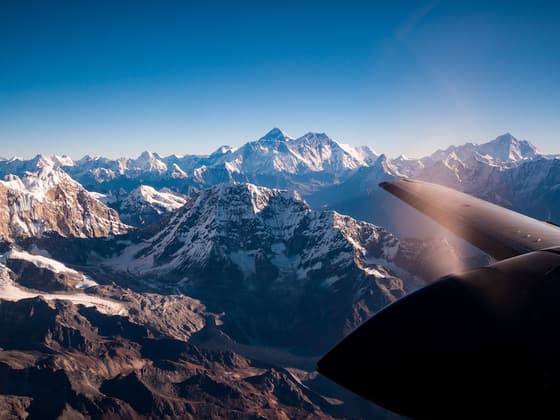
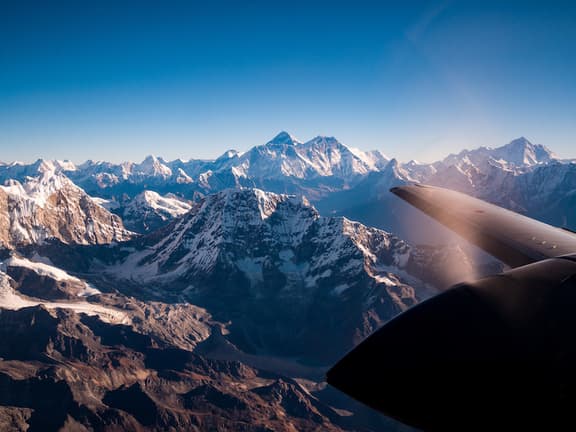

Photo: Hiroki Ogawa, CC BY 3.0, via Wikimedia Commons. Everest and Lhotse seen on a Himalayan mountain flight from Kathmandu.
This is a what-to-expect guide, not a guest diary. It walks through a typical first Everest flight morning as Himalayan Social Journey runs it. Your own morning will depend on the airline, the weather and the airport on the day.
The Everest scenic flight is one of the few ways to see the world's highest mountain without trekking for days. The flight is about an hour. Counting the transfers and check-in, the whole outing takes around three hours, and it starts well before most of Kathmandu is awake. Here is how the morning usually unfolds, from the hotel lobby to the window seat and back.
Before dawn: the wake-up call and the weather read
Your morning starts with a call from our representative. It's a wake-up call, but it's also the morning's weather read. These flights only go in clear conditions, so the call is as much a go/no-go as an alarm.
Mountain flights usually take off very early, often around 6:00 AM, because the air is clearest before the day warms up. Have three things ready the night before:
your passport or ID
a fully charged camera or phone
a warm layer, because the airport is cold at that hour
Only small personal items are allowed in the cabin, so leave the big bag in your room.
In the hotel lobby
You come down to the lobby at the pickup time we've given you. Your driver collects you there, and you don't need to arrange a taxi or find your own way to the airport. Airport transfers in both directions are part of the package.
The lobby wait is a good moment for a final check: passport, camera, warm layer. If you have mobility needs or are nervous about flying in a small aircraft, tell your HSJ representative. Wheelchair facilities can be arranged when requested at booking, and it's better that the people looking after you know what you need.
The transfer to Tribhuvan
The drive goes to the domestic terminal at Tribhuvan International Airport, not the international one. Kathmandu is barely awake at this hour, but we still allow for traffic. The early start isn't for show: it's there to catch the clear mountain air.
Check-in at the domestic terminal
At the terminal you check in at your airline's counter, collect your boarding pass and clear security. Certified Nepali airlines operate the flight, typically Buddha Air, Yeti Airlines or Shree Airlines, and we confirm your airline when you book.
After security there's usually time for tea or coffee in the waiting area before boarding is called. This is also where the weather can still have the final say. Mountain flights depend on visibility, so a departure can be held or cancelled even after you reach the airport.
Boarding: every seat is a window seat
You board a small propeller aircraft, typically with 15 to 18 seats, set up so that every seat is a window seat. Nobody on this flight sits in the middle, and a window seat is guaranteed for every passenger. Before take-off the crew goes through the route and names the peaks you'll see.
Take-off and the climb toward the range
The aircraft lifts out of Kathmandu, at about 1,400 m, and turns toward the Himalaya. Within minutes the city gives way to green hills, and the first white summits appear on the horizon. The pilot gives live commentary, naming each mountain as it comes into view.
At the window
At its closest point the aircraft comes within about 32 km of the summit of Everest (8,849 m). The pilot banks gently so passengers on both sides get a clear line to the mountain. On a clear morning the peaks around it can include Lhotse, Makalu, Cho Oyu, Ama Dablam and Kangchenjunga. The early light is the whole reason for the early start.
One photography tip: hold your camera slightly away from the window rather than pressing it against the glass. That cuts out most of the reflections. It's also worth putting the camera down for a minute and simply looking.
Back to Kathmandu
The aircraft turns back toward the valley, and the peaks stay off the wing for a while before the range slips behind the foothills. After landing at Tribhuvan, every passenger is handed a personalised Everest Flight Certificate. Your driver then takes you back to your hotel, usually in time for a full breakfast, with the rest of the day in Kathmandu still ahead of you.
If the weather says no
It's best to plan for this possibility from the start. The flight only operates when visibility allows, and that call is made on the morning itself. If the flight is cancelled because of weather, you get a full refund, including the hotel transfer. If your schedule allows, you can ask to rebook for the next available morning instead. Building a spare morning into your Kathmandu days gives you that option.
Price at a glance
The Daily Everest Scenic Flight with Airport Transfer costs USD 180 for Indian passport holders and USD 280 for other passport holders. That includes hotel pickup and drop-off, the flight ticket, a guaranteed window seat, airport taxes and the flight certificate. Meals are not included. For a broader look at how mountain flight prices work in Nepal, read our guide to the cost of a mountain flight in Nepal.
Quick checklist for your first flight morning
Passport or ID
Charged camera or phone
A warm layer for the cold airport
Small personal items only
Any mobility needs or nerves mentioned in advance
A spare morning in your plans in case of weather
Reviewed by Amrit Sapkota, Himalayan Social Journey