Overview
Most people who come to Nepal spend their days ascending — mountains, valleys, altitude. Osho Tapoban invites you to go inward instead.
Just 5 kilometres from the noise of Kathmandu, through the edge of Nagarjun National Forest, sits one of Asia's most respected spiritual communes. Osho Tapoban — also written Osho Tapovan — is an ashram in the truest sense, and it has been welcoming seekers from more than ninety countries for decades — not as a resort, not as a wellness hotel, but as a living, breathing community built around the teachings of Osho and the daily practice of meditation.
An overnight stay here is unlike anything else on a Nepal itinerary. You arrive, you slow down, you disconnect from your schedule. You join the commune's daily rhythm — morning meditation, yoga, satsang, communal meals, evening stillness. By the time you leave the next morning, something shifts. Trekkers who arrive exhausted leave restored. Travellers who arrive overstimulated leave quiet.
This is not a day spa. It is something older and more honest than that.
Location — Nagarjun Forest, Kathmandu Valley
Osho Tapoban sits inside the Nagarjun forest on the northern edge of the Kathmandu Valley. From Balaju (a short taxi or rickshaw ride from Thamel), the commune is about 5 kilometres up a forested road. The transition is immediate — within minutes of leaving the city traffic, you are surrounded by pine and rhododendron trees, birdsong, and the kind of silence that Kathmandu itself rarely offers.
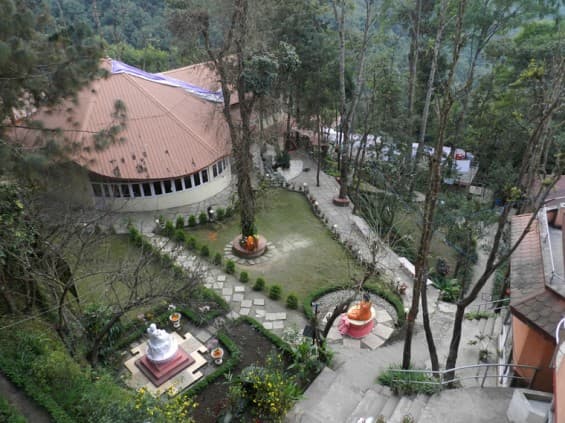
The commune is entirely self-contained. Accommodation, meditation halls, a communal kitchen, gardens, and walking paths through the forest — everything you need is within a short walk. There is no reason to leave once you arrive, and most guests find they don't want to.
The photos on this page were taken at the ashram — the meditation hall, the gardens, the guest rooms and the forest around them.
What to Expect During Your Stay
Life at Osho Tapoban follows a gentle, intentional schedule. Here is the rhythm of a typical overnight visit:
Afternoon arrival (Day 1)
You arrive and check in to your accommodation — simple, clean twin-sharing rooms that face the forest. After settling in, you are free to walk the grounds, explore the meditation garden, or simply sit and decompress. The pace is immediately slower here. Nobody is rushing anywhere.
Evening meditation and satsang
As the light changes in the forest, the commune gathers for evening meditation. Depending on the schedule, this may be Kundalini Meditation — a one-hour active session of movement, shaking, dancing, and stillness — or a quieter sitting practice. Satsang follows: a communal gathering for reflection, discourse, and presence. You don't need experience or belief to participate. You only need to show up.
Dinner
Meals at Tapoban are vegetarian, simple, and surprisingly satisfying. The commune kitchen prepares everything fresh. Dinner is eaten communally, in the kind of unhurried quiet that makes you realise how rarely you actually taste your food.
Morning meditation (Day 2)
The day begins early at Tapoban. Pre-dawn Dynamic Meditation — Osho's signature morning practice — involves five stages of breathwork, catharsis, mantra, stillness, and dance. You will feel strange doing it. You will feel better when it ends. Attendance is optional but strongly encouraged.
Yoga
After meditation, morning yoga is offered — a grounding practice suited to all levels. The forest air at this hour is cool and clear. It is a genuinely good way to spend an hour.
Breakfast and departure
Breakfast is included. After eating, guests are free to explore the forest paths, sit in the gardens, or simply be before checking out. Most people find they want more time.
What does an overnight at Osho Tapoban cost?
The current price per person is shown at the top of this page, and it is one figure covering everything the stay needs: return transport between Kathmandu and the commune, a night of twin-sharing accommodation facing the forest, three vegetarian meals, the morning yoga session, and evening meditation and satsang. There is nothing further to pay once you are inside. The commune has no bar and alcohol is not permitted on the grounds, so the only extras are the personal things you choose to bring with you.
What the price does not cover is travel insurance, your own clothing and equipment, and any therapy or activity outside the communal schedule. If you would rather not share a room, say so when you book and we will put the request to the commune.
Can you stay longer than one night?
This package is a 2-day, 1-night stay, which is the shortest visit that still includes the pre-dawn Dynamic Meditation — the practice most people come for. One night is enough to feel the pace change, and most guests say on the morning of departure that they wish they had booked more.
If you want longer, tell us how many nights you have in mind and we will put the request to the commune; stays of several nights are common among people who come specifically to practise. If what you are after is a full week of structured practice rather than a stay in the commune itself, our 7-Day Yoga Retreat in Pharping runs a week-long programme at a Buddhist monastery on the other side of the valley.
Who Is This Experience For?
You do not need to be a meditator. You do not need to know who Osho was. You do not need any particular belief system or spiritual background.
This overnight is ideal for:
- Trekkers recovering after a long expedition — EBC, Annapurna Circuit, or any demanding route. One night at Tapoban resets your nervous system in a way that a Kathmandu hotel cannot.
- Travellers who want one genuinely different night — not another hotel, not another tourist dinner, but something that will stay with them.
- People already interested in meditation or yoga — this is a rare chance to practice in a living commune, not just a class.
- Anyone who needs to slow down — the Kathmandu Valley is overwhelming. Tapoban is the antidote.
The commune is not suitable for children under 12, and guests are asked to respect the community's guidelines around noise, alcohol (not permitted on the grounds), and the schedule of communal activities.