
Makalu to Langtang Trek via Sherpani Col, Tashi Lapcha and Tilman Pass
A 42-day traverse of the high Himalaya from Makalu to Langtang, over Sherpani Col and West Col (6,190 m), Amphu Laptsa, Tashi Lapcha and Tilman Pass. Five high passes, three national parks and the wild middle of the Great Himalaya Trail, camping most of the way with our own crew.
Trip Highlights
- Five high passes in one trek: Sherpani Col, West Col, Amphu Laptsa, Tashi Lapcha and Tilman Pass
- Makalu Base Camp, under the south face of the fifth highest mountain in the world
- The glaciers of the Barun plateau and the wild upper Hongu valley
- Amphu Laptsa and the view down to Island Peak and Lhotse
- A rest in Namche Bazaar and the old Sherpa village of Thame
- Tashi Lapcha and the Drolambau glacier into Rolwaling
- Tsho Rolpa, Na and Beding, the quiet villages under Gauri Shankar
- The sacred lakes of Panch Pokhari
- Tilman Pass under the Jugal Himal, named after the explorer Bill Tilman
- Kyanjin Gompa and the Langtang valley
- A long section of the Great Himalaya Trail walked by very few people
Trip Overview
Last updated
Day-by-Day Itinerary
Our team meets you at Tribhuvan International Airport and takes you to your hotel. In the evening your trek leader comes to say hello and gives you a short briefing on the trek.
We need your passport for the permits, so this day is spent on paperwork and gear. Your guide checks your boots, crampons, harness and warm clothes, and helps you rent anything you are missing. In the afternoon we go through the route, the passes and the safety plan.
A short flight takes us east to Tumlingtar in the Arun valley. From there we drive along the ridge through Khandbari to Num, a village above the Arun river where our crew joins us.
We cross the Arun and drive up to Seduwa, then start walking through terraced fields and Rai villages to Tashigaon. This is the last village on the way to Makalu.
A long, steady climb through rhododendron and bamboo forest takes us up onto the ridge at Khongma Danda. It is a big height gain, so we walk slowly and drink a lot.
We cross two passes today, Shipton La (4,125 m) and Keke La (4,170 m), past small lakes. On a clear morning you can see Makalu, Chamlang and Kanchenjunga. We camp at Dobato (3,860 m).
A steep descent through forest brings us down to the Barun river. We follow it upstream, under high waterfalls, to the pastures of Yangle Kharka.
The valley opens up above the tree line. We walk through yak pastures with views of Peak 6 and Peak 7 to the summer grazing ground at Langmale Kharka.
A short walk up the moraine brings us to Makalu Base Camp, right under the huge south face of Makalu (8,485 m).
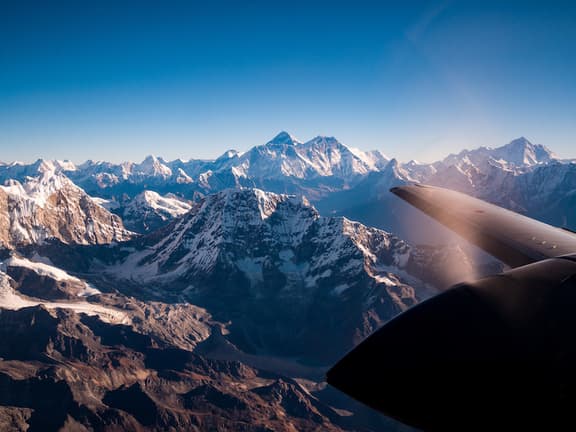
A day to rest before going higher. In the morning we walk up the moraine to about 5,200 m for the view of Makalu, Lhotse and Everest, and come back to sleep at base camp. In the afternoon your guide goes through crampons, harness and rope work.
We leave the trekking route and follow the moraine of the Barun glacier to Swiss Camp. From here on there are no trails, only our guides' route over rock and ice.
A climb over boulders and the edge of the glacier takes us to our high camp below Sherpani Col. We go to bed early for the crossing tomorrow.
We start before dawn and climb on snow and rock to Sherpani Col (6,180 m). On the far side our guides fix a rope and lower everyone down a steep snow and rock slope onto the Barun plateau, a wide glacier basin under Baruntse. We camp on the plateau at about 5,700 m.
We walk across the plateau and climb to West Col (6,190 m), the highest point of the trek. Our guides fix a rope for the descent into the upper Hongu valley, and we walk down to Baruntse Base Camp at about 5,400 m.
This is a spare day for bad weather on the cols. If we crossed on time, it is a rest day in the Hongu, one of the most remote valleys in Nepal.
We walk down the Hongu past the small glacial lakes of Panch Pokhari (the Hongu lakes, not the ones near Langtang) to camp at the foot of Amphu Laptsa.
The climb to Amphu Laptsa (5,845 m) is steep but short. The north side is a steep wall of ice and rock, and our guides lower you on a fixed rope, one at a time. Below, the trail goes down to the Imja valley under Island Peak and Lhotse, and we walk to Chhukung for our first lodge night in two weeks.
A long but easy walk downhill, past Dingboche, Pangboche and Tengboche monastery, to Namche Bazaar (3,440 m). It is a big day, but the trail is good and the air gets thicker with every step.
A full rest day. Take a hot shower, wash clothes, charge your devices and enjoy the bakeries. The crew restocks food and fuel for the next section.
We walk west up the Bhote Koshi valley to Thame (3,800 m), the old Sherpa village on the trade route to Tibet, and on to the pastures of Thyangbo.
We climb above the last pastures to Ngole, a rocky camp below the Tashi Lapcha.
A short, steep climb over loose rock brings us to a high camp under the pass. Your guide checks the route and the snow for the morning. Watch for falling stones on this section and keep close to your guide.
We start early, while the snow is hard, and climb to the Tashi Lapcha (5,755 m). From the top you look west over Rolwaling. Our guides fix rope on the steep descent onto the Drolambau glacier, and we walk roped up past crevasses to camp at the foot of the glacier, at about 5,000 m.
We leave the ice and walk along Tsho Rolpa, one of the biggest glacial lakes in Nepal, down to the summer village of Na.
We follow the Rolwaling river down to Beding (3,690 m), the main village of the valley, with its small monastery. After lunch we carry on down through forest to camp at Dongang, at about 2,900 m.
The trail drops through forest to Simigaon (2,000 m), a Tamang and Sherpa village above the Tamakoshi, and then steeply down to the road at Gonggar (1,440 m).
A long drive by jeep through the hills via Charikot takes us west to the Bhote Koshi valley, near the road to Tibet. This is our second resupply point. Hot shower and a bed tonight.
We start the last big section of the trek with a long climb out of the Bhote Koshi through villages and forest to Bagam.
A steady climb through rhododendron forest to the high pastures of Chogormogor Kharka, with views of the Jugal Himal.
Over a ridge and down a long way through forest to Tembathang, a small Hyolmo village in the Indrawati valley.
A long climb back up through forest and pastures to Nosyampati, also called Nema Chukpa Kharka.
A shorter day up to Panch Pokhari, five sacred lakes under the Jugal Himal. Hindu and Buddhist pilgrims come here every August for the full moon festival.
A rest day before we go high again. Walk around the lakes or up the ridge above camp for the view of the Jugal Himal and Dorje Lakpa.
We head north along the ridge to Tin Pokhari, three small lakes, and the last good water before the pass.
A rough walk over moraine and rock to our high camp on the south side of Tilman Pass. Water here can be snow melt only.
We cross the Tilman Pass (about 5,310 m), the last of the five passes. The climb is on rock and snow, and the north side can hold deep snow, so our guides go first and make the track. There are big views of Langtang Lirung, Gangchenpo and the Langtang glacier. We camp on the north side at about 4,600 m.
A short walk down the glacier to the pastures of Langshisa Kharka in the upper Langtang valley. This short day is also our spare time if the pass took longer.
An easy walk down the wide valley to Kyanjin Gompa, with its old monastery and cheese factory. Back to lodges, hot showers and fresh bread.
We follow the Langtang river down through Langtang village and into the forest to Lama Hotel.
The last day on foot, down through the forest to Syabrubesi on the road. In the evening we say thank you to the crew.
We drive back to Kathmandu through the hills. The rest of the day is yours. If a flight or pass was delayed, this day is also our buffer.
Our team takes you to the airport in time for your flight home.
Route & altitude
42 days
What’s Included
Departure dates
Recommended Gear
Frequently Asked Questions
It is one of the hardest treks we run. You walk for 36 days, cross five passes between 5,310 m and 6,190 m, and sleep above 5,000 m for about ten nights. The pass days are 8 to 10 hours on snow, ice and loose rock. We grade it 5 of 5, Extreme.
You do not need to be a climber, but you must have trekked above 5,000 m before and be steady on steep, exposed ground. You will walk in crampons and use a harness, an ice axe and a fixed rope on Sherpani Col, West Col, Amphu Laptsa and Tashi Lapcha. If you have not used crampons, we practise at Makalu Base Camp before the first col.
Sherpani Col and West Col are the hardest, with a rope descent on the far side of Sherpani Col and a steep, rocky climb to West Col. Amphu Laptsa has a steep ice and rock wall on the Chhukung side, where we lower you on a rope. Tashi Lapcha has rockfall and crevasses, so we cross early and walk roped on the glacier. Tilman Pass is less steep but long and remote, with deep snow possible on the north side.
Yes. This trek follows the high route of the Great Himalaya Trail from Makalu to Langtang, about a third of the high route across Nepal. It joins the Makalu Barun, Everest, Rolwaling, Panch Pokhari and Langtang regions in one trip.
Yes. We also run the first part as Makalu to Everest via Sherpani Col (25 days) and the middle as the Rolwaling and Tashi Lapcha Pass Trek (19 days). We can also plan the Tilman Pass and Panch Pokhari section on its own. Ask us and we will send you an itinerary.
October and November are the best months, with clear skies and stable weather on the high passes. April and May are possible, but there is more snow on the passes and cloud in the afternoons. We do not run this trek in the monsoon (June to September) or in winter, when the passes are closed by snow.
There are no lodges on most of the route. Between Tashigaon and Chhukung, between Thame and the Bhote Koshi, and from there to Langtang, there are only pastures and empty valleys. Our crew carries tents and food and cooks for you. You stay in lodges in Num, Chhukung, Namche, the Bhote Koshi, Kyanjin Gompa, Lama Hotel and Syabrubesi.
We go up slowly through the Arun and Barun valleys, with a rest day at Makalu Base Camp before going higher. After Amphu Laptsa we drop to Namche to recover, and the middle of the trek is lower before the Tilman Pass. Your guide checks your oxygen level and how you feel every day. If you show signs of altitude sickness, you go down with a guide.
We have spare days at Baruntse Base Camp, Namche, Panch Pokhari and after Tilman Pass. If a pass is not safe, we wait. If the weather stays bad, your leader decides on the safest way out, which can mean going round a pass on a lower route. Safety always comes before the plan.
Your guide stays with you and takes you down. In clear weather a helicopter can reach most of the route, but there is no phone signal in many places, so it can take hours to call one. This is why we go slowly and turn back early, and why your insurance must cover trekking to 6,200 m and helicopter rescue. Please send us your policy before the trek.
You need entry permits for Makalu Barun, Sagarmatha and Langtang national parks, the Gaurishankar Conservation Area permit, the Rolwaling restricted area permit and the Khumbu local fee. We arrange all of them in Kathmandu on day 2. The Rolwaling permit needs at least two trekkers and a licensed guide.
Groups are 2 to 10 people. If you are on your own, ask us. We can match you with other trekkers on the same dates, or run a private trip for you with a guide, which costs more.
Our cook makes three meals a day: porridge, eggs and bread for breakfast, a hot lunch, and soup, dal bhat, pasta, potatoes and fresh vegetables for dinner, with tea and coffee. We restock fresh food in Namche and on the Bhote Koshi. Tell us about any special diet when you book.
We boil or filter all drinking water at camp. Bring your own filter or tablets for the day too. On the high camps the water is melted snow, so it takes time; please keep your bottles filled when you can.
You need warm clothes for -15°C or colder, stiff insulated boots that take crampons, crampons, a harness, an ice axe, a helmet and a four-season sleeping bag. All the climbing gear and the sleeping bag can be rented in Kathmandu. See the full gear list on this page. The rope and group gear are ours.
You can charge in the lodges, usually for a small fee. At camp, bring a power bank and a small solar panel if you can. There is a phone signal in Namche, around the Bhote Koshi and in parts of Langtang, but none on most of the route.
Very fit. You should be able to walk 7 to 9 hours a day with a daypack, day after day, on steep ground. Start training at least three months before: long hill walks with a pack, stair climbing and some running or cycling. If you have a health problem, check with your doctor first.
Tips are not included and are up to you. Many trekkers give about 10 to 15 percent of the trip price for the whole team, shared between guides, cook, kitchen crew and porters. Your leader can help you share it fairly at the end.
The Makalu to Langtang Trek costs US$9,200 per person for groups of 2 to 10. It includes the Tumlingtar flight, all ground transport, permits, camping, three meals a day on the trek, your guides and crew, and 3 nights in Kathmandu. International flights, insurance, personal climbing gear and tips are not included.
Traveler Stories
Traveler Reviews
Really excellent day! Rajan was my tour guide and he was excellent. Explained every historical site and the background behind it and was very informative the whole day. He made sure I was ok always, gave good reccomendations for delicious food and we got to sp…
We really enjoyed our tour of the 7 UNESCO sites today. Dipendra was very informative and told us all about the history and fascinating facts of the many temples we visited. This is a full day trip and I would recommend it to anyone visiting Kathmandu.
A great way to see all of the important sites in Kathmandu in just one day! The guide, Dipendra was great! Informative and funny!
Dioendra our guide was terrific!!! Professional, punctual, very knowledgeable We visit 7 UNESCO sites and spend several hours knowing the fascinating and magical Nepalese culture…. Wonderful time !!! Highly recommended this tour with Dioendra!!