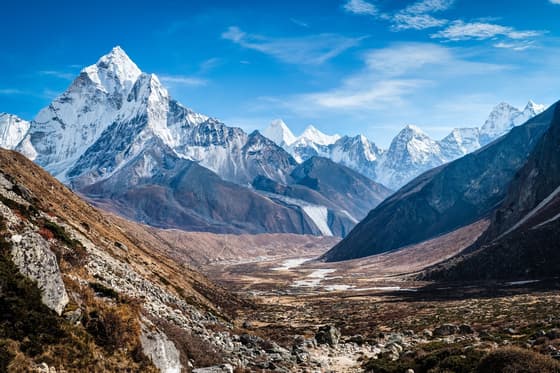

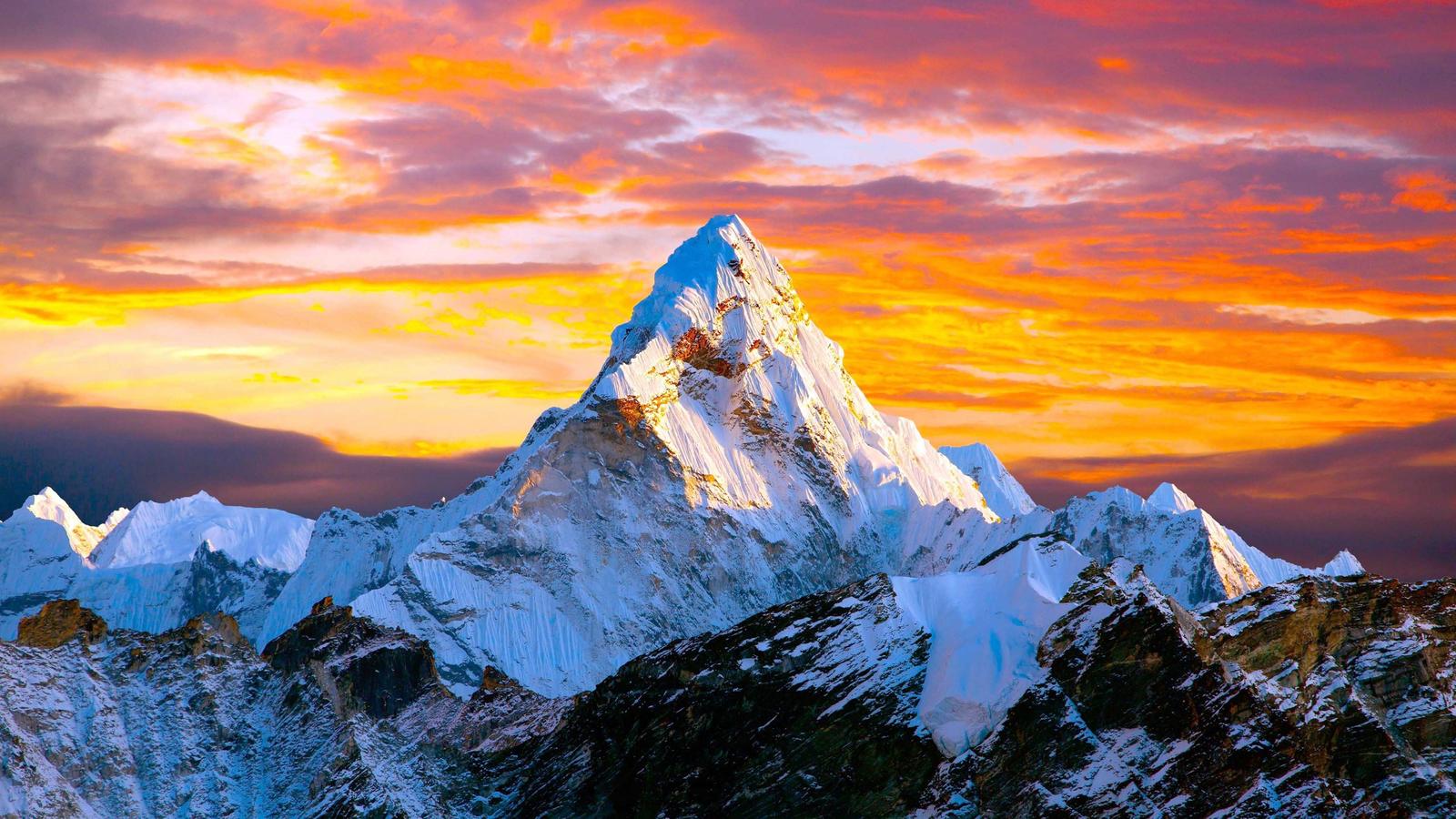
Mount Everest, called Sagarmatha in Nepal and Chomolungma in Tibet, is the tallest mountain in the world at 8,849 meters (29,032 feet) above sea level. It sits on the Nepal-China border. Behind it come 13 more peaks over 8,000 meters, all in the Himalaya or Karakoram ranges of Nepal, Pakistan, India, and China.
This list matters for more than trivia. Eight of the world's 14 highest mountains rise inside Nepal, and most can be seen, or trekked toward, without technical climbing skill. Below is the full ranking, what "tallest" really means, and how close an ordinary trekker can get.
What does "tallest mountain" actually mean?
"Tallest" and "highest" get used as if they were the same word, but they are not.
- Highest above sea level: Everest wins, at 8,849 m. This is the measure almost everyone means by "tallest mountain in the world."
- Tallest from base to peak: Mauna Kea in Hawaii rises about 10,200 m from the Pacific seafloor to its summit, but only about 4,207 m of that is above water. Measured base to summit, it is taller than Everest.
- Farthest from Earth's center: Chimborazo in Ecuador, at 6,263 m, sits on the planet's equatorial bulge. Its summit is roughly 2,000 m farther from Earth's center than Everest's.
For this article, "tallest" follows the common meaning: elevation above sea level. By that measure, Everest is first, and the next 13 spots are all held by other Himalayan and Karakoram giants.
The 14 highest mountains in the world
These are the only mountains on Earth above 8,000 meters, known among climbers as the "eight-thousanders." All 14 were first climbed between 1950 and 1964.
| Rank | Mountain | Height (m) | Height (ft) | Location | First ascent |
|---|---|---|---|---|---|
| 1 | Mount Everest (Sagarmatha) | 8,849 | 29,032 | Nepal / China | 1953 |
| 2 | K2 (Chhogori) | 8,611 | 28,251 | Pakistan / China | 1954 |
| 3 | Kangchenjunga | 8,586 | 28,169 | Nepal / India | 1955 |
| 4 | Lhotse | 8,516 | 27,940 | Nepal / China | 1956 |
| 5 | Makalu | 8,485 | 27,838 | Nepal / China | 1955 |
| 6 | Cho Oyu | 8,188 | 26,864 | Nepal / China | 1954 |
| 7 | Dhaulagiri I | 8,167 | 26,795 | Nepal | 1960 |
| 8 | Manaslu | 8,163 | 26,781 | Nepal | 1956 |
| 9 | Nanga Parbat | 8,126 | 26,660 | Pakistan | 1953 |
| 10 | Annapurna I | 8,091 | 26,545 | Nepal | 1950 |
| 11 | Gasherbrum I | 8,080 | 26,509 | Pakistan / China | 1958 |
| 12 | Broad Peak | 8,051 | 26,414 | Pakistan / China | 1957 |
| 13 | Gasherbrum II | 8,035 | 26,362 | Pakistan / China | 1956 |
| 14 | Shishapangma | 8,027 | 26,335 | China (Tibet) | 1964 |
Annapurna I, ranked 10th by height, was actually the first 8,000 m peak ever climbed, in 1950, three years before Everest. Shishapangma is the only eight-thousander entirely within one country, Tibet (China), and the last of the 14 to be summited.
Where are the world's tallest mountains located?
Eight of the 14 eight-thousanders sit on Nepal's border or fully inside the country: Everest, Kangchenjunga, Lhotse, Makalu, Cho Oyu, Dhaulagiri, Manaslu, and Annapurna. The other six (K2, Nanga Parbat, Gasherbrum I and II, Broad Peak) are in Pakistan's Karakoram range, and Shishapangma is in Tibet. No eight-thousander exists outside Asia; the highest peaks on other continents, like Aconcagua in South America (6,961 m) or Denali in North America (6,190 m), are far lower.
Can you see these mountains without climbing them?
Yes. Seeing a mountain and summiting it are different trips, and most visitors want the first one. Nepal's trekking trails run through valleys directly below several eight-thousanders, close enough to see rock, ice, and seracs without a rope or an expedition permit.
A few routes that put trekkers at or near the base of these peaks:
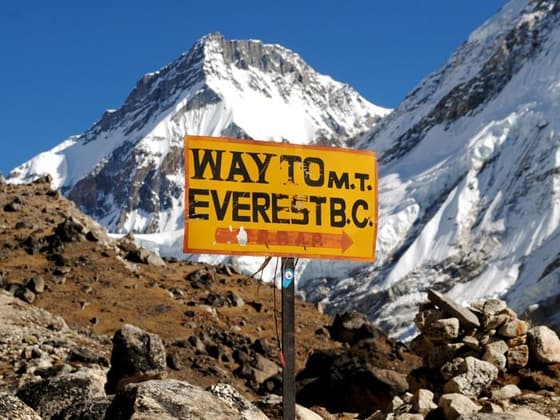
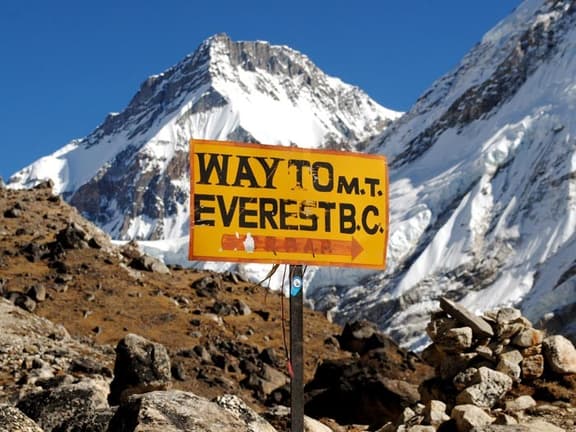
- Everest Base Camp Trek – 14 days, reaches Everest Base Camp at 5,364 m and Kala Patthar at 5,545 m for the closest non-technical view of Everest. See HSJ's Everest Base Camp Trek.
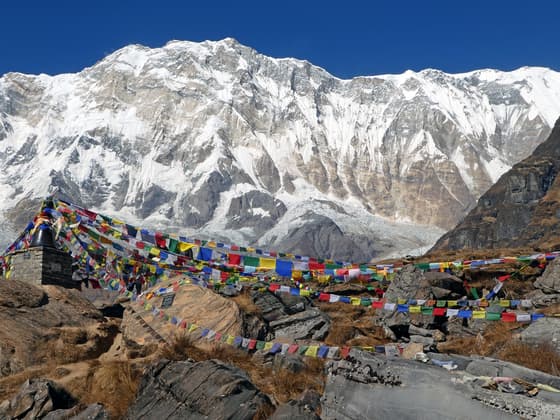
- Annapurna Base Camp Trek – 16 days, ends inside a natural amphitheater at 4,130 m surrounded by Annapurna I and Machhapuchhre. See HSJ's Annapurna Base Camp Trek.
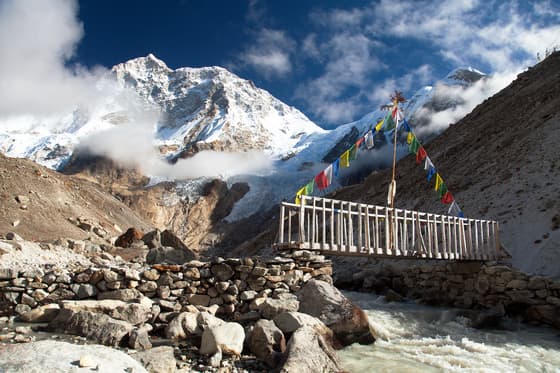
- Makalu Base Camp Trek – 19 days, a quieter, less-trekked route to the base of the world's 5th highest peak. See HSJ's Makalu Base Camp Trek.
- Kanchenjunga Circuit Trek – 22 days, circles the world's 3rd highest mountain through one of Nepal's most remote regions. See HSJ's Kanchenjunga Circuit Trek.
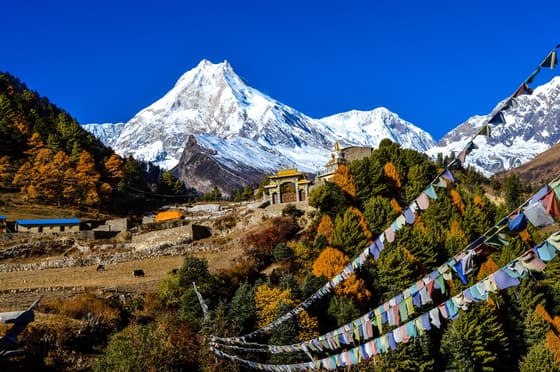
- Manaslu Circuit Trek – 15 days, crosses Larkya La (5,106 m) with close views of the world's 8th highest peak. See HSJ's Manaslu Circuit Trek.
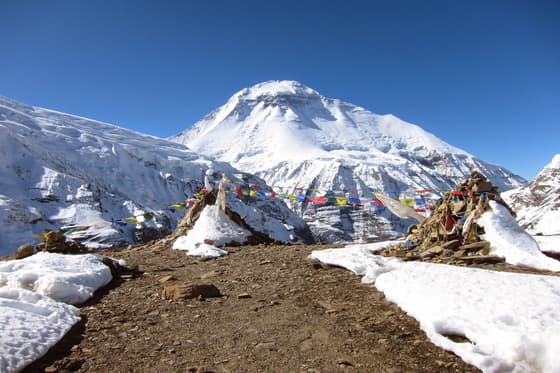
- Dhaulagiri Circuit Trek – 21 days, a demanding high-altitude route around the world's 7th highest mountain. See HSJ's Dhaulagiri Circuit Trek.
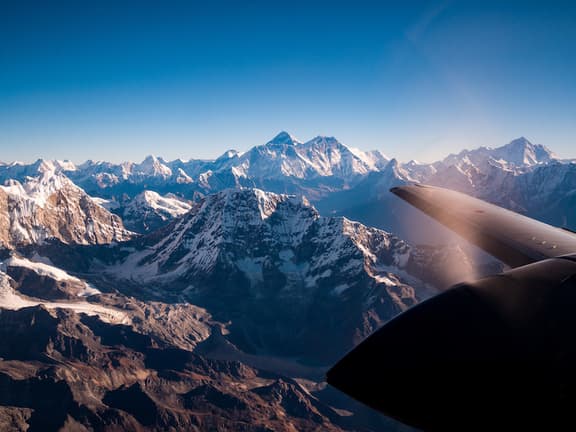
For a shorter option, a scenic mountain flight or helicopter tour from Kathmandu passes within view of Everest, Lhotse, and Makalu in about an hour, with no trekking at all. Explore HSJ's Everest region trips and helicopter tours for options.
Do you need to be a climber to see Mount Everest?
No. Everest Base Camp is a trek, not a climb. There is no technical climbing, rope work, or summit permit involved, only a multi-day walk on marked trails with overnight stops in teahouses. Reasonable fitness, a few weeks of preparation, and a guide familiar with altitude are enough for most healthy adults. Climbing Everest itself is a separate, far more serious undertaking requiring mountaineering experience, an expedition team, and government permits.
What it costs and takes to actually climb the tallest peaks
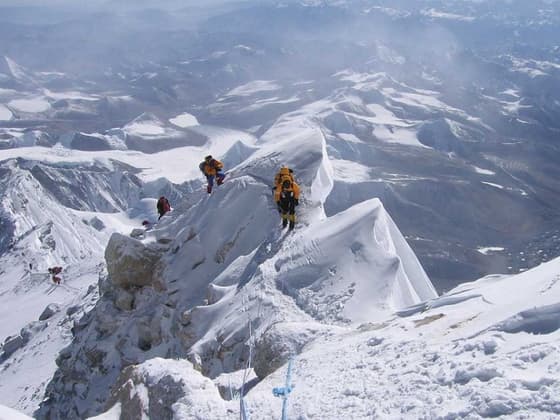
Climbing an eight-thousander is a different category of trip from trekking to its base. Nepal's Department of Tourism issues a climbing royalty (permit fee) for each peak, priced by season and by mountain height. Everest's permit is the most expensive of the 14 and has been raised more than once in recent years as the government tries to manage crowding on the route. Full expeditions on peaks like Everest, Manaslu, or Cho Oyu typically run 40 to 60 days total, including acclimatization rotations through the Khumbu Icefall or equivalent terrain, and require a licensed guiding company, oxygen above 7,000–8,000 m for most climbers, and a dedicated Sherpa/climbing crew.
HSJ organizes expeditions on three of these peaks:
- Mt. Everest Expedition (8,849 m) – 60 days
- Mt. Cho Oyu Expedition (8,188 m) – 45 days
- Mount Manaslu Expedition (8,163 m) – 40 days
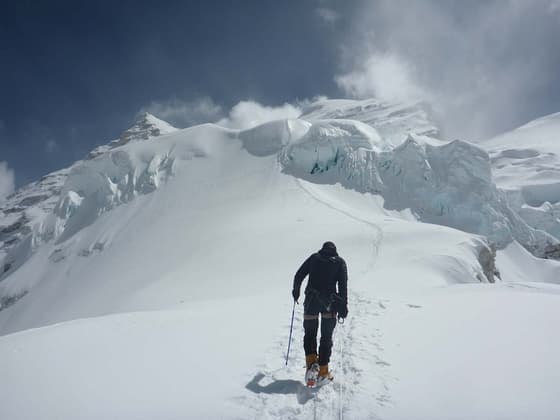
For climbers working up to an eight-thousander, Nepal's lower "trekking peaks" (6,000–6,500 m) are a common training step. See HSJ's peak climbing trips, including Island Peak and Mera Peak, both under 6,500 m and climbable without prior 8,000 m experience.
Best time to see Nepal's highest mountains
Two windows give the clearest mountain views and the most stable weather for both trekking and climbing:
- Spring (March to May): Warming temperatures, rhododendrons in bloom at lower elevations, and this is the main Everest climbing season.
- Autumn (September to November): The clearest skies of the year, after the monsoon has washed the dust out of the air, and the most popular trekking season.
Winter (December to February) is cold but doable on lower routes like Annapurna Base Camp, with fewer crowds. Summer (June to August) brings the monsoon to most of Nepal, with clouded views and landslide risk on trails, though the rain-shadow regions of Upper Mustang and Dolpo stay relatively dry and walkable. For a full season-by-season breakdown, see HSJ's guide on the best time to trek in Nepal.
Permits and rules worth knowing before you go
Every trek or climb near these peaks in Nepal requires permits, and rules have changed in recent years, including a 2023 requirement for a licensed guide on most independent treks. Before booking, check:
- Current TIMS/local area permit requirements and fees for your chosen region
- Sagarmatha National Park entry fees for Everest-region treks
- Climbing royalty fees for the specific peak and season, if attempting a summit
- Nepal's visa-on-arrival rules and fees for your nationality
For official, current figures, check the Nepal Tourism Board and the Department of Tourism, Government of Nepal. HSJ keeps its own guides updated too: see the solo trekking rule update and Nepal visa on arrival guide.
Planning your own trip to the world's tallest mountains
If the goal is to stand near the base of the highest mountains on Earth rather than summit them, Nepal is the easiest and safest way to do it. Trails are established, teahouses exist at regular intervals, and guides are available for every route listed above. Start by browsing HSJ's full range of trekking trips in Nepal or expedition tours if climbing is the actual goal, and build a trip around the season and altitude you're ready for.
How does Everest compare to the highest peak on each continent?
Climbers use the term "Seven Summits" for the highest mountain on each continent. Everest is the tallest of the seven by a wide margin, and the only one that requires expedition-level climbing for almost everyone who attempts it.
| Continent | Mountain | Height (m) | Height (ft) |
|---|---|---|---|
| Asia | Mount Everest | 8,849 | 29,032 |
| South America | Aconcagua (Argentina) | 6,961 | 22,838 |
| North America | Denali (USA) | 6,190 | 20,310 |
| Africa | Kilimanjaro (Tanzania) | 5,895 | 19,341 |
| Europe | Elbrus (Russia) | 5,642 | 18,510 |
| Antarctica | Vinson Massif | 4,892 | 16,050 |
| Oceania | Puncak Jaya (Indonesia) | 4,884 | 16,024 |
The gap is stark: Everest stands almost 1,900 m above the second-highest of the seven, Aconcagua. That difference in altitude is also why Everest needs supplemental oxygen for most climbers above 7,500–8,000 m, while Aconcagua and Kilimanjaro are climbed by thousands of people each year without it.
Frequently asked questions
What is the tallest mountain in the world?
Mount Everest, 8,849 m (29,032 ft), on the Nepal-China border. It has been the highest point above sea level since measurement began, and remains the benchmark for "tallest mountain" worldwide.
What are the 14 tallest mountains in the world?
The 14 "eight-thousanders" are Everest, K2, Kangchenjunga, Lhotse, Makalu, Cho Oyu, Dhaulagiri I, Manaslu, Nanga Parbat, Annapurna I, Gasherbrum I, Broad Peak, Gasherbrum II, and Shishapangma. All sit in the Himalaya or Karakoram ranges of Nepal, Pakistan, India, and China.
How many of the world's tallest mountains are in Nepal?
Eight of the 14 eight-thousanders are in Nepal, either fully inside the country or on its border: Everest, Kangchenjunga, Lhotse, Makalu, Cho Oyu, Dhaulagiri, Manaslu, and Annapurna.
Is Mount Everest the tallest mountain measured from base to peak?
No. Measured from base to summit, Hawaii's Mauna Kea is taller, rising about 10,200 m from the Pacific seafloor, though only about 4,207 m shows above the water. Everest is the highest above sea level, which is what most people mean by "tallest."
Can a beginner trek to the base of Mount Everest?
Yes. The Everest Base Camp Trek is a walking trip on established trails with teahouse lodging, not a technical climb. Reasonable fitness and a guide experienced with altitude are enough for most healthy adults; no climbing skill is required.
What is the best season to see these mountains clearly?
Autumn (September to November) gives the clearest skies of the year. Spring (March to May) is the second-best window and the main climbing season for Everest and other eight-thousanders.