★ 4.8/5 TripAdvisor★ 4.7/5 Google★ 4.7/5 TourRadar
Enjoy Up to 45% OffView Deals
+977 9810650405info@hsj.com.np
TripAdvisor · Travelers’ Choice 2026

Nepal · Everest Region

Everest Three Passes Trek — 19 Days | Cost & Itinerary 2026

19 Days
Difficulty · 4/5
Max 5,545 m
Group 2–14 pax

Cross Kongma La, Cho La and Renjo La in 19 days — Everest Base Camp, Kala Patthar, Gokyo Ri and the turquoise Gokyo Lakes in one ultimate Khumbu circuit. From $1,200.

Duration
19 Days
18 nights
Max Altitude
5,545 m
Highest point
Difficulty
4
4 out of 5
Group Size
2–14
people
Best Season
Feb, Mar, April, May, June, Sep, Oct, Nov & Dec
Activity / Day
6-7 Hours Walking

Trip Highlights

  • Cross all three great passes of the Khumbu — Kongma La (5,535 m), Cho La (5,420 m) and Renjo La (5,360 m)
  • Stand at Everest Base Camp (5,364 m) beneath the Khumbu Icefall
  • Sunrise from Kala Patthar (5,545 m) — the classic close-up of Everest's summit pyramid
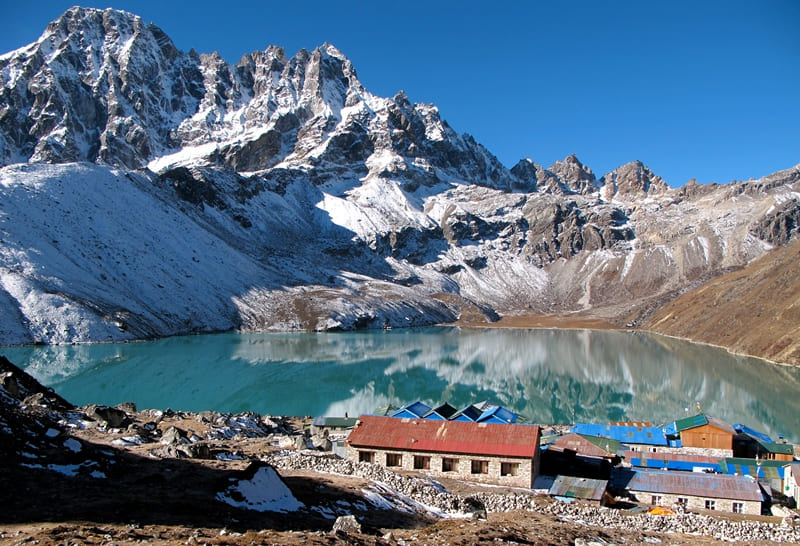
  • Climb Gokyo Ri (5,357 m) above the turquoise Gokyo Lakes — many call it the finest viewpoint in Nepal
  • Walk beside the Ngozumpa Glacier, the longest glacier in the Himalayas
  • Four 8,000 m giants in view — Everest, Lhotse, Makalu and Cho Oyu
  • Visit Tengboche Monastery and the quiet yak villages of the Thame valley on the descent
  • 19 days with two built-in acclimatisation days — the complete Khumbu circuit in one trek

Trip Overview

If Everest Base Camp is the most famous trek in Nepal, the Everest Three Passes Trek is the most complete. In 19 days it links everything the Khumbu has to offer — Base Camp, Kala Patthar, the Gokyo Lakes and Gokyo Ri — by crossing the three great passes that wall the region's valleys: Kongma La (5,535 m), Cho La (5,420 m) and Renjo La (5,360 m). It is the ultimate Everest circuit, and one of the finest high treks anywhere on earth.

The route follows the classic trail through Namche Bazaar and Tengboche to Dingboche, with two acclimatisation days built in. From Chhukung the circuit begins in earnest: the crossing of Kongma La, the highest and most demanding of the three passes, drops you into Lobuche on the Everest Base Camp trail. From there the route takes in Base Camp itself and the dawn climb of Kala Patthar at 5,545 m — the highest point of the trek, face to face with Everest's summit pyramid.

The second crossing, Cho La, leads over a small glacier into the Gokyo valley — a different world of turquoise lakes strung beneath the Ngozumpa Glacier, the longest in the Himalayas. The climb of Gokyo Ri at sunrise reveals what many consider the single best panorama in Nepal: Everest, Lhotse, Makalu and Cho Oyu in one sweep, with the lakes glowing below. The final pass, Renjo La, completes the circuit with one last staggering view of Everest before descending into the quiet, rarely visited Thame valley and back to Namche.

This is a trek for fit, experienced walkers. Graded 4/5, it spends eleven consecutive days above 4,000 m and crosses three passes above 5,300 m — pass days start before dawn and run 7–9 hours. There is no technical climbing, but micro-spikes are used on the Cho La glacier crossing in colder months. The reward for the effort is the Khumbu in its entirety — every valley, every viewpoint, every angle of Everest.

Best seasons: March–May and October–November. The passes are usually snowbound and significantly harder from December to February; the monsoon obscures the views from June to August.

About the Lukla flight: During peak seasons (March–May and October–November), regulations require flights to Lukla to depart from Ramechhap (Manthali) Airport — roughly 4–5 hours from Kathmandu by road. HSJ arranges a vehicle departure at 1:00–2:00 AM to reach Ramechhap in time for the early morning flight. During the off-season, flights depart directly from Kathmandu in 35 minutes.

Not sure this is your trek? The classic Everest Base Camp Trek (14 days) covers Base Camp and Kala Patthar without the passes, while the Gokyo Ri & EBC Trek (17 days) adds the Gokyo Lakes with just one pass crossing. Contact us and we will help you choose.

A Typical Day on the Trek

Breakfast is served by 7:00 am and most days start walking by 7:30–8:00 am to use the clear morning skies. Standard days cover 8–12 km in 5–6 hours with lunch at a teahouse mid-route, arriving at the next village by mid-afternoon to rest, rehydrate and recharge before dinner at 6:00–7:00 pm.

The three pass days are different: wake-up is 3:30–4:30 am, walking by headlamp to cross the pass before the wind rises, with 7–9 hours on the trail. Your guide checks everyone's oxygen saturation daily with a pulse oximeter, and the two acclimatisation days at Namche and Dingboche are active rest days — climb high, sleep low. Lights-out is by 9:00 pm; above 4,000 m, sleep is the best acclimatiser there is.

Photo Gallery

Day-by-Day Itinerary

01
Day 1
Arrival in Kathmandu
Max 1,400 mHimalayan Suite Hotel, Kathmandu

Your HSJ representative meets you at Tribhuvan International Airport and transfers you to the Himalayan Suite Hotel. The rest of the day is free to rest or explore Thamel. In the evening your guide conducts a full trek briefing — permits, gear check, the pass crossings and what to expect over the next three weeks.

02
Day 2
Fly to Lukla and Trek to Phakding
Max 2,840 mFly 35 min + Trek 3–4 hrsKhumbu Inn or similar, Phakding

An early transfer for the 35-minute flight to Lukla (2,840 m) — one of the world's most dramatic airstrips, perched on a Himalayan ridgeline. From Lukla the trail descends gently through pine forest along the Dudh Koshi River to Phakding, crossing the first of many suspension bridges. A relaxed first day to let the body register the altitude.

03
Day 3
Trek to Namche Bazaar
Max 3,440 mTrek 6–7 hrsHotel Sherpaland or similar, Namche Bazaar

The trail follows the Dudh Koshi upstream, enters Sagarmatha National Park at Monjo and crosses the Hillary Suspension Bridge before the sustained 800 m climb to Namche Bazaar — the trading heart of the Khumbu. On a clear afternoon, the first views of Everest appear above the ridgeline.

04
Day 4
Acclimatisation Day at Namche — Hike to Hotel Everest View
Max 3,880 mHike 3–4 hrsHotel Sherpaland or similar, Namche Bazaar

A rest day built around the climb-high-sleep-low principle. The morning hike ascends to the Hotel Everest View (3,880 m) for an unobstructed panorama of Everest, Lhotse and Ama Dablam. The afternoon is free for Namche's Sherpa Culture Museum, the market, bakeries and good coffee.

05
Day 5
Trek to Deboche via Tengboche
Max 3,820 mTrek 5–6 hrsRivendell Lodge or similar, Deboche

The trail traverses the high ridge above the Dudh Koshi with Ama Dablam commanding the skyline, then drops to the river and climbs through forest to Tengboche Monastery — the largest in the Khumbu, set against a 270-degree mountain panorama. A short descent through rhododendron forest leads to the quieter village of Deboche for the night.

06
Day 6
Trek to Dingboche
Max 4,410 mTrek 5–6 hrsMountain Paradise Guesthouse or similar, Dingboche

Crossing the Imja Khola, the trail climbs through Pangboche — home to one of the oldest monasteries in the region — and on through thinning vegetation into the wide glacial valley of Dingboche at 4,410 m. Ama Dablam, Island Peak and the great wall of Lhotse fill the horizon.

07
Day 7
Acclimatisation Day at Dingboche — Hike to Nangkartsang Peak
Max 5,083 mHike 4–5 hrsMountain Paradise Guesthouse or similar, Dingboche

A second acclimatisation day with a demanding hike to Nangkartsang Peak (5,083 m) — your first time above 5,000 m and a vital test before the passes. The summit views stretch from Makalu to Cho Oyu. The afternoon is for rest, hydration and an early night.

08
Day 8
Trek to Chhukung
Max 4,730 mTrek 3–4 hrsTeahouse, Chhukung

A short day up the Imja valley to Chhukung at 4,730 m, directly beneath the immense south face of Lhotse. The light afternoon leaves energy in reserve — tomorrow is the first and highest pass. Optional acclimatisation walk towards Chhukung Ri viewpoint.

09
Day 9
Cross Kongma La Pass to Lobuche
Max 5,535 mTrek 8–9 hrsSherpa Lodge or similar, Lobuche

The first great crossing. A pre-dawn start for the long climb to Kongma La at 5,535 m — the highest of the three passes — marked by prayer flags and a small glacial lake, with vast views of Makalu, Lhotse and the Khumbu peaks. The descent crosses the rubble of the Khumbu Glacier before reaching Lobuche. The hardest day of the trek, and one of the most rewarding.

10
Day 10
Trek to Gorak Shep and Everest Base Camp
Max 5,364 mTrek 7–8 hrsBuddha Lodge or similar, Gorak Shep

An early start along the glacier moraine to Gorak Shep (5,190 m), where bags are dropped before the push to Everest Base Camp at 5,364 m. The trail follows the glacier edge to the foot of the legendary Khumbu Icefall — in spring, the tent city of summit expeditions spreads across the ice. Return to Gorak Shep for the highest night of the trek.

11
Day 11
Sunrise on Kala Patthar, Descend to Lobuche
Max 5,545 mHike 2 hrs + Trek 3–4 hrsSherpa Lodge or similar, Lobuche

A 4:30 am start by headlamp for the climb to Kala Patthar (5,545 m) — the highest point of the trek and the definitive close-up of Everest, its summit pyramid catching the first light barely eight kilometres away. After breakfast at Gorak Shep, an easy descent retraces the moraine to Lobuche.

12
Day 12
Trek to Dzongla
Max 4,830 mTrek 3–4 hrsTeahouse, Dzongla

A short, scenic traverse above the turquoise Chola Tsho lake to the small huddle of lodges at Dzongla, set beneath the fluted ice walls of Cholatse. An afternoon of rest before the second pass — early dinner, early bed.

13
Day 13
Cross Cho La Pass to Gokyo
Max 5,420 mTrek 8–9 hrsTeahouse, Gokyo

Another pre-dawn start for Cho La (5,420 m). The eastern approach climbs steep rock; the pass itself holds a small glacier, crossed carefully with micro-spikes in colder months. The descent through Thagnak leads across the vast grey expanse of the Ngozumpa Glacier — the longest in the Himalayas — to the third Gokyo lake, where the village sits on luminous turquoise water.

14
Day 14
Climb Gokyo Ri, Rest at Gokyo
Max 5,357 mHike 4–5 hrsTeahouse, Gokyo

Sunrise from Gokyo Ri (5,357 m) is, for many trekkers, the single finest viewpoint in Nepal: Everest, Lhotse, Makalu and Cho Oyu in a single sweep, with the chain of Gokyo lakes glowing below. The rest of the day is free to explore the lakes or simply absorb the setting.

15
Day 15
Cross Renjo La Pass to Lungden
Max 5,360 mTrek 7–8 hrsTeahouse, Lungden

The final crossing. The trail climbs steadily from the lake to Renjo La (5,360 m), where Everest frames itself between prayer flags one last time — many consider this the most beautiful of the three pass views. The long stone staircase descends into the remote, rarely visited Bhote Koshi valley and the yak-herding hamlet of Lungden.

16
Day 16
Trek to Namche Bazaar via Thame
Max 3,440 mTrek 6–7 hrsHotel Sherpaland or similar, Namche Bazaar

A long descent through the quiet Thame valley — the homeland of many of Everest's most famous Sherpa climbers, including Tenzing Norgay and Apa Sherpa. Thame's hillside monastery is one of the oldest in the Khumbu. The trail rejoins the main route at Namche for a celebratory evening — bakeries, hot showers and the satisfaction of the circuit completed.

17
Day 17
Trek to Lukla
Max 2,840 mTrek 6–7 hrsMera Lodge or similar, Lukla

The final day on the trail retraces the Dudh Koshi valley through Monjo and Phakding to Lukla. A farewell dinner with your trekking crew closes out the journey — nineteen days, three passes, and the entire Khumbu behind you.

18
Day 18
Fly to Kathmandu
Max 1,400 mFly 35 minHimalayan Suite Hotel, Kathmandu

Morning flight from Lukla back to Kathmandu or Manthali (Ramechhap) depending on season, and transfer to the Himalayan Suite Hotel. The rest of the day is free — Thamel, a massage, or simply a long rest at low altitude.

19
Day 19
Departure
Max 1,400 m

Your HSJ representative transfers you to Tribhuvan International Airport in time for your onward flight. If your departure is later in the day, there is time for a final visit to Pashupatinath or Boudhanath. Safe travels — and we hope to see you on another HSJ adventure soon.

What’s Included

Included
Airport pick-up and drop-off (Kathmandu)
2 nights hotel in Kathmandu — Himalayan Suite Hotel (twin-sharing, bed & breakfast)
16 nights teahouse accommodation on trail (twin-sharing, breakfast included; attached bathrooms with hot shower up to Namche)
Round-trip Kathmandu/Ramechhap–Lukla flights with all airport transfers
English-speaking licensed trekking guide (full 19 days)
One porter for every two trekkers (up to 15 kg per porter)
All guide and porter wages, meals, accommodation and insurance
Sagarmatha National Park entry permit
Khumbu Pasang Lhamu Rural Municipality permit
Micro-spikes for the Cho La glacier crossing (October–April)
Sleeping bag rated to -20°C and duffel bag (provided by HSJ if required)
First aid kit with pulse oximeter — daily oxygen saturation checks
HSJ trekking map, company T-shirt and trip completion certificate
Welcome dinner on Day 1
All government taxes, VAT and service charges
Not Included
Lunch and dinner during the trek (paid directly at teahouses, approx. $5–9 per dish, rising with altitude)
Lunch and dinner in Kathmandu
Travel insurance (mandatory — must cover trekking to 6,000 m and helicopter evacuation)
Nepal entry visa fees and international flights
Personal trekking gear and clothing
Hot showers, Wi-Fi and battery charging on trail (small fee at each teahouse)
Tips for guide and porter (customary — approx. $10–15/day guide, $5–8/day porter)
Personal expenses (drinks, snacks, souvenirs)

Everest Three Passes Trek — 19 Days | Cost & Itinerary 2026 Departures

No scheduled departures right now.

Contact us to arrange a private departure →

Route Map

View Map
Starts
Kathmandu
Ends
Kathmandu Airport

Altitude Profile

1.4km2.4km3.5km4.5km5.5km1.4km5.5km1.4kmD1D3D5D7D9D11D13D15D17D19
Highest Point5,545m

Recommended Gear

Moisture-wicking base layers (2 sets, top and bottom)
Thermal mid-layer fleece
Heavy down jacket (for pass mornings and evenings above 4,500 m)
Waterproof and windproof shell jacket and trousers
Trekking trousers (2 pairs)
Warm hat covering ears
Sun hat or cap
Neck gaiter or buff
Glove system — liner gloves + insulated waterproof outer
Broken-in waterproof hiking boots with ankle support
Lightweight camp shoes or sandals
Trekking socks (5–6 pairs, wool)
Warm sleeping socks
Gaiters
Micro-spikes for the Cho La glacier crossing (provided by HSJ October–April)
Daypack 30–35 L with rain cover
Trekking poles — essential for the pass descents
Sleeping bag rated to -20°C (provided by HSJ if required)
Headlamp with spare batteries — three pre-dawn pass starts
Power bank 20,000 mAh (charging is scarce and expensive above Dingboche)
Water bottles or hydration bladder (2 L) + insulated cover
Water purification tablets or SteriPen
Glacier-rated wraparound sunglasses (UV400)
Sunscreen SPF 50 and lip balm with SPF
Lightweight microfibre towel
Cash in NPR — budget $30–40/day for lunch and dinner on the trail (not included)
Passport and 2 passport photos
Travel insurance documents (must cover 6,000 m + heli evacuation)
Personal medications
Diamox (acetazolamide) — discuss with your doctor
Blister plasters and moleskin
Ibuprofen and paracetamol
Rehydration salts
Hand sanitiser and wet wipes
Toilet paper
Earplugs
Snacks — energy bars, nuts, chocolate for pass days
Camera or phone with spare memory

Traveler Reviews23 verified

E
Erik B★★★★★
Verified Purchase

Me and my friend had an amazing experience with HSj from the first moment to the last. Mingmar met us at the airport and Kathmandu and made sure that we got everything we needed before taking the flight to Lukla. After a…

Read More 👀
I
Isaac4001★★★★★
Verified Purchase

We booked a two person, private, 16 day trek (Three passes) with Himalayan Social Journey during late September - mid October 2023. We had been recommended HSJ from a friend. The correspondence from the company was quick…

Read More 👀
I
Ingrid S★★★★★
Verified Purchase

I would like to thank Ram, Bisnu and Ciandra for an excellent experience in the Himalaya mountains. The good service and the careing team made the three passes trekk an unforgettable adventure for me. I would recommend t…

Read More 👀
T
Taher★★★★★
Verified Purchase

Really excellent day! Rajan was my tour guide and he was excellent. Explained every historical site and the background behind it and was very informative the whole day. He made sure I was ok always, gave good reccomendat…

D
Dave★★★★★
Verified Purchase

We really enjoyed our tour of the 7 UNESCO sites today. Dipendra was very informative and told us all about the history and fascinating facts of the many temples we visited. This is a full day trip and I would recommend …

G
Greg★★★★★
Verified Purchase

A great way to see all of the important sites in Kathmandu in just one day! The guide, Dipendra was great! Informative and funny!

G
Gloria★★★★★
Verified Purchase

Dioendra our guide was terrific!!! Professional, punctual, very knowledgeable We visit 7 UNESCO sites and spend several hours knowing the fascinating and magical Nepalese culture…. Wonderful time !!! Highly recommended t…

E
Elizabeth W★★★★★
Verified Purchase

Guide was awesome. Really made the trip more special. I understand so much more about the History and culture of Nepal than without a wonderful guide. There was no questions he could not answer. Was a once in a lifetime …

N
Natalie★★★★★
Verified Purchase

We had an amazing day with Dipendra! We spent so much great quality time at each site. He provided deep explanation on the history of each monument, took us to some interesting authentic places and overall shared informa…

B
Barry★★★★★
Verified Purchase

A fantastic day touring the 7 Unesco sights of Kathmandu! Our guide, Dipendra, was extremely knowledgeable and informative and we finished the tour with a great appreciation of Nepalese culture!

B
Bodhi★★★★★
Verified Purchase

We had wonderful time with our guide, Dipendra exploring the 7 UNESCO sites! He was very flexible with how much time and areas we like to be at along with his knowledge of the sites. Thank you for Dipendra a great memory…

S
Sabine★★★★★
Verified Purchase

Our guide Rajan knew absolutely everything. He was very empathetic, answered all our questions, and made this tour an unforgettable experience.

Traveler Stories

KimEverest Base Camp Trek
Deck and StrebellaNagarkot Sunrise Tour with Sallaghari-Changunarayan Hiking
DavidKathmandu - Pokhara Sightseeing with Everest Scenic Flight & Annapurna Heli tour

Frequently Asked Questions

March–May and October–November. The passes need stable, clear weather — autumn offers the most reliable conditions and sharpest views, while spring adds warmer days and rhododendron colour lower down. From December to February the passes are usually snowbound and crossings become significantly harder and sometimes impossible; the monsoon (June–August) hides the views and makes the Lukla flight unreliable.
Significantly harder. Graded 4/5, the route spends eleven consecutive days above 4,000 m and crosses three passes above 5,300 m, each involving a pre-dawn start and 7–9 hours of walking. The standard EBC trek touches high altitude briefly; the Three Passes lives there. Good fitness, prior multi-day trekking experience and respect for altitude are essential.
Kongma La (5,535 m) from Chhukung to Lobuche, Cho La (5,420 m) from Dzongla to the Gokyo valley, and Renjo La (5,360 m) from Gokyo to the Thame valley. We cross anti-clockwise — hardest pass first while you are freshly acclimatised from two rest days, finishing with the easiest. The circuit also includes Everest Base Camp, Kala Patthar, Gokyo Ri and the Gokyo Lakes.
Kala Patthar at 5,545 m is the highest point, followed closely by Kongma La at 5,535 m. You sleep as high as Gorak Shep (5,190 m). The itinerary builds altitude gradually with acclimatisation days at Namche Bazaar and Dingboche before the first pass.
No technical climbing skills are required — all three passes are walking routes. The one exception is the small glacier crossing on Cho La, where micro-spikes are used in colder months; your guide carries them and will show you how to fit them. Trekking poles are strongly recommended for the long, steep descents off each pass.
Take it seriously — this is a genuinely high route. The itinerary includes two acclimatisation days and follows a climb-high-sleep-low profile, and your guide carries a pulse oximeter and checks everyone daily. Report headaches, nausea or poor sleep immediately. If symptoms develop, the route offers several descent options between the passes.
Two permits are required: the Sagarmatha National Park entry permit and the Khumbu Pasang Lhamu Rural Municipality permit. Both are arranged and included by HSJ. Bring your passport and two passport-size photos.
Breakfast is included at the Kathmandu hotel and at teahouses on the trail. Lunch and dinner during the trek are paid directly at teahouses — typically $5–9 per dish, rising with altitude where supplies arrive by yak or porter. Budget approximately $30–40 per day for trail meals.
During peak seasons (March–May and October–November), regulations require Lukla flights to depart from Ramechhap (Manthali) Airport, about 4–5 hours from Kathmandu by road. HSJ arranges a vehicle at 1:00–2:00 AM to connect with the early morning flight. In the off-season, flights go directly from Kathmandu (35 minutes). Build 1–2 buffer days into your international flights — Lukla weather delays are common.
15 kg total per passenger — 10 kg in your duffel for the porter plus 5 kg hand luggage. Excess weight may be charged or refused at check-in. Leave everything you do not need on the trail in free storage at the Himalayan Suite Hotel in Kathmandu.
Comfortable and well-run up to Dingboche, simpler above. Rooms are twin-share; bathrooms are mostly shared above Namche. Chhukung, Dzongla, Gorak Shep and Lungden are small high-altitude settlements with basic lodges — expect simple menus, cold rooms and modest facilities. Dining rooms are heated in the evenings and the hospitality is genuine everywhere.
Yes at most stops up to Dingboche — hot showers cost NPR 300–600 and device charging NPR 200–500 per item, with prices rising with altitude. Above 4,700 m, expect a bowl of warm water rather than a shower. Bring a 20,000 mAh power bank and keep electronics warm at night — cold drains batteries fast.
Namche, Dingboche, Lobuche and Gorak Shep have paid Wi-Fi (Everest Link cards) and patchy NTC/Ncell signal. The Gokyo and Thame valleys are quieter — coverage is intermittent at best. Tell family to expect gaps of a day or two between messages on the pass sections.
A four-season sleeping bag rated to -20°C, serious down jacket, full waterproof shell, broken-in boots, micro-spikes (provided by HSJ for the Cho La crossing), gaiters, trekking poles, headlamp with spare batteries, glacier-rated sunglasses and a 20,000 mAh power bank. A complete packing list is in the Gear section on this page and is sent with your booking confirmation.
You should be comfortable walking 6–8 hours on consecutive days with a daypack, including big ascents and descents. In the 8–12 weeks before the trek, train with long back-to-back day hikes, stair sessions or hill repeats, and general cardio. The fitter you arrive, the more you will enjoy the pass days rather than merely survive them.
Yes. The circuit can be trimmed to two passes, run clockwise on request, or shortened by skipping Base Camp (the passes and Gokyo are the scenic heart). Helicopter return from Gokyo or Lukla can also be arranged. All HSJ departures can run as private trips on any date for two or more trekkers.
Yes — mandatory, and it must cover trekking to 6,000 m and emergency helicopter evacuation. The remoteness of the pass sections makes this non-negotiable. Check the altitude clause on your policy carefully before travelling; many standard policies stop at 3,000 m.
A 20% deposit secures your booking; the balance is due 30 days before departure. Cancellations more than 30 days out receive a full deposit refund; within 30 days a 50% fee applies. We recommend booking international flights with flexible dates given the Lukla weather factor.
Everest Three Passes Trek — 19 Days | Cost & Itinerary 2026 — Select a Departure Date
$ 1,200.00
/ person
$ 1,700.0029% OFF
Reserve with $ 240.00 — pay the rest later
Free cancellation · No hidden fees
4.9★ · 2,004+ TripAdvisor reviews
18 Years+ Experience
Why Trek with HSJ
Small GroupsMax 12 trekkers for a personal experience
Local Sherpa GuidesBorn & raised in the Himalaya
All Permits IncludedNo hidden fees or surprises
7% of profit donated

Through the Himalayan Community Project, we fund education, healthcare & conservation in rural Nepal.

Amrit SapkotaAswin SapkotaRam SapkotaUsha DhakalNirajan Khanal
Ram & TeamBased in Kathmandu 🇳🇵
Chat

Business Group

We have a whole business chain to cater to your different needs.
We Are Associated With

Partnered with trusted organizations to ensure quality and reliability.
Nepal Tourism Board
NATTA
TAAN
Nepal Mountaineering Association
$ 1,200.00per person