



How to Prepare for Your First High-Altitude Adventure ?
You've done the MacRitchie loop, climbed Bukit Timah Hill more times than you can count, and now you're eyeing something bigger like Everest Base Camp, Annapurna, Mt Kinabalu, Rinjani. Maybe even Kilimanjaro. The problem? Backpacking for trekking Singapore-style means leaping from sea level and 30°C humidity to thin air, freezing nights, and a 12kg pack on your back. The jump is real, and most first-timers underestimate it.
This guide walks you through choosing the right pack, building a gear list that survives the tropical-to-alpine swing, training around Singapore's flat geography, and where to buy what you need locally. No fluff — just what helps you arrive at the trailhead ready.
Backpacking, Trekking, Mountaineering
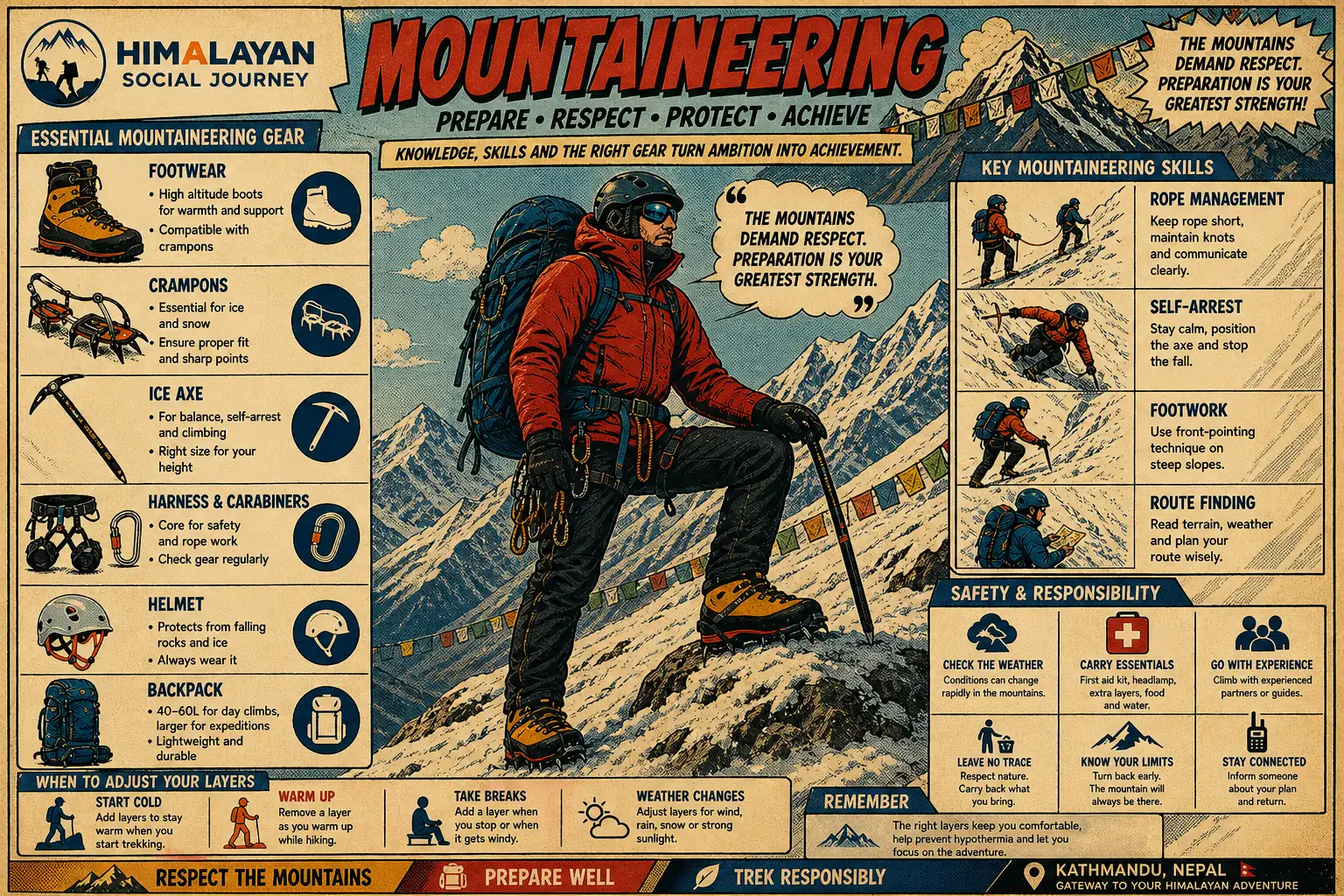
These three terms get mashed together, but they describe different activities.
Backpacking is the umbrella term for travelling on foot with everything you need carried on your back. The focus is self-sufficiency over multiple days. So how to do the backpacking properly so that you can hike for a couple of hours without difficulty ?
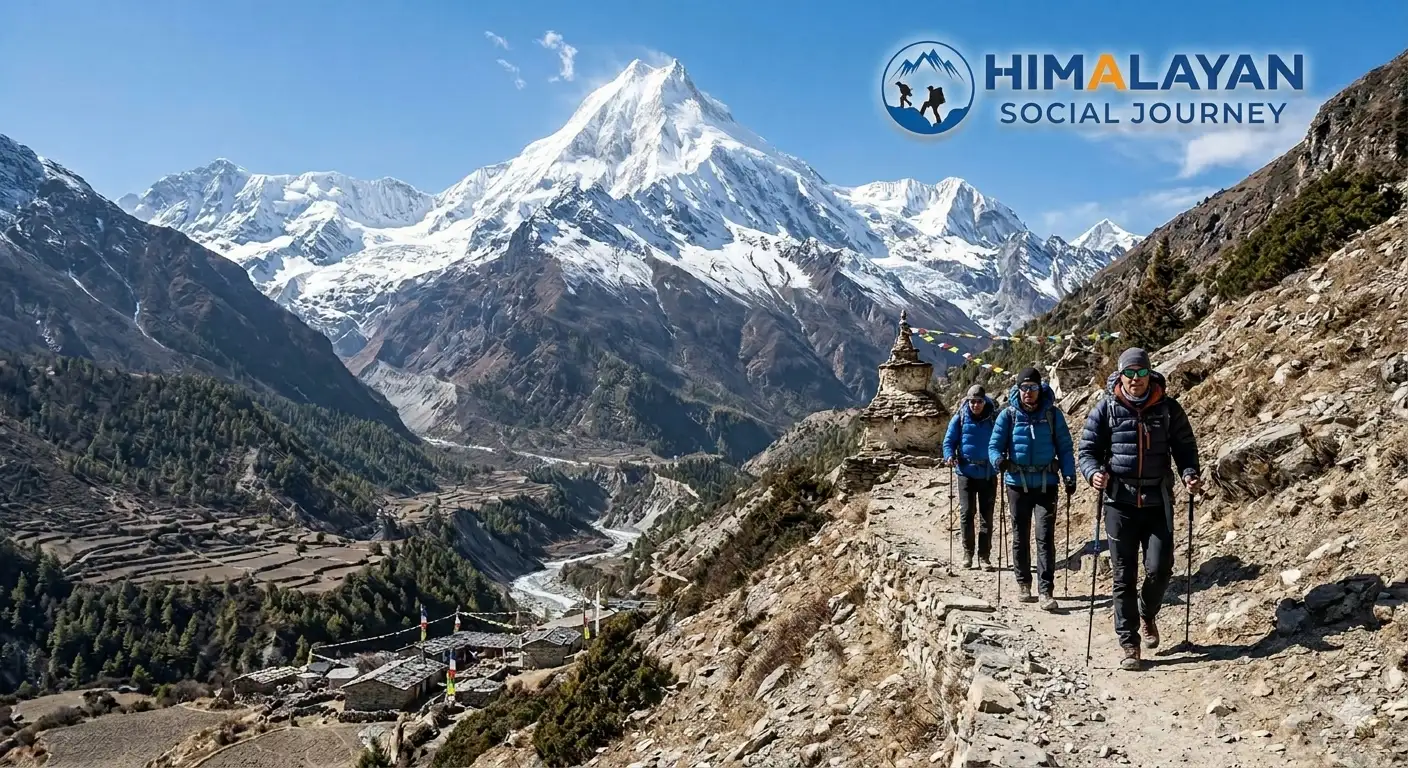
Trekking is multi-day hiking on established trails, usually with overnight stops at teahouses, lodges, or campsites. Annapurna Circuit and Everest Base Camp are treks graded, well-trodden, but altitude makes them serious. EBC tops out at roughly 5,364m; the Annapurna Circuit's Thorong La Pass sits even higher.
Mountaineering involves technical terrain, snow, ice, ropes, crampons, or summit pushes above the treeline where weather and altitude are unforgiving. Mt Kinabalu's via ferrata is a light taste of mountaineering. Kilimanjaro's summit night sits at the soft edge of it. Anything above 6,000m is the real thing.
Most Singaporeans starting out are doing backpacking-style multi-day treks with a sprinkle of altitude. This guide stays in that lane.
Choosing the Right Pack: Your Mountaineering Backpack Guide
Your pack is the single most important purchase. Get this wrong and the whole trip suffers.
Hiking Backpack Size: How Many Litres?
Match capacity to trip length and to how much your porters or duffel transfers carry for you:
30–40L — day hikes and supported treks where porters or yaks carry your duffel (typical EBC and Kilimanjaro setups). You only carry layers, water, snacks, camera, documents.
50–65L — self-supported teahouse treks of four to ten days. Annapurna Circuit, Rinjani three-day trips. Enough room for sleeping bag, layers, and personal gear.
65–85L — fully self-supported expeditions where you carry tent, stove, and food. Most weekend trekkers won't need this.
For Mt Kinabalu, where you do a single overnight at Laban Rata and the lodge supplies bedding, a 35–45L pack is plenty.
Frame Type and Fit
Internal-frame packs hug your back and handle uneven terrain better than external frames, which is why almost every modern trekking pack uses one. What matters more is torso length, not your overall height. Measure from the C7 vertebra (the bony bump at the base of your neck when you tilt your head forward) down to the top of your iliac crest. Most Singapore retailers will fit you in-store take the time to do this properly.
Women's-Specific Fits
Women's packs aren't a marketing gimmick. They have shorter torso ranges, narrower shoulder straps, and hip belts shaped for a different pelvis. If you're a woman or a smaller-framed man, try the women's range. Fit beats brand every time.
The Packing System That Saves Your Back
How you pack matters as much as what you pack.
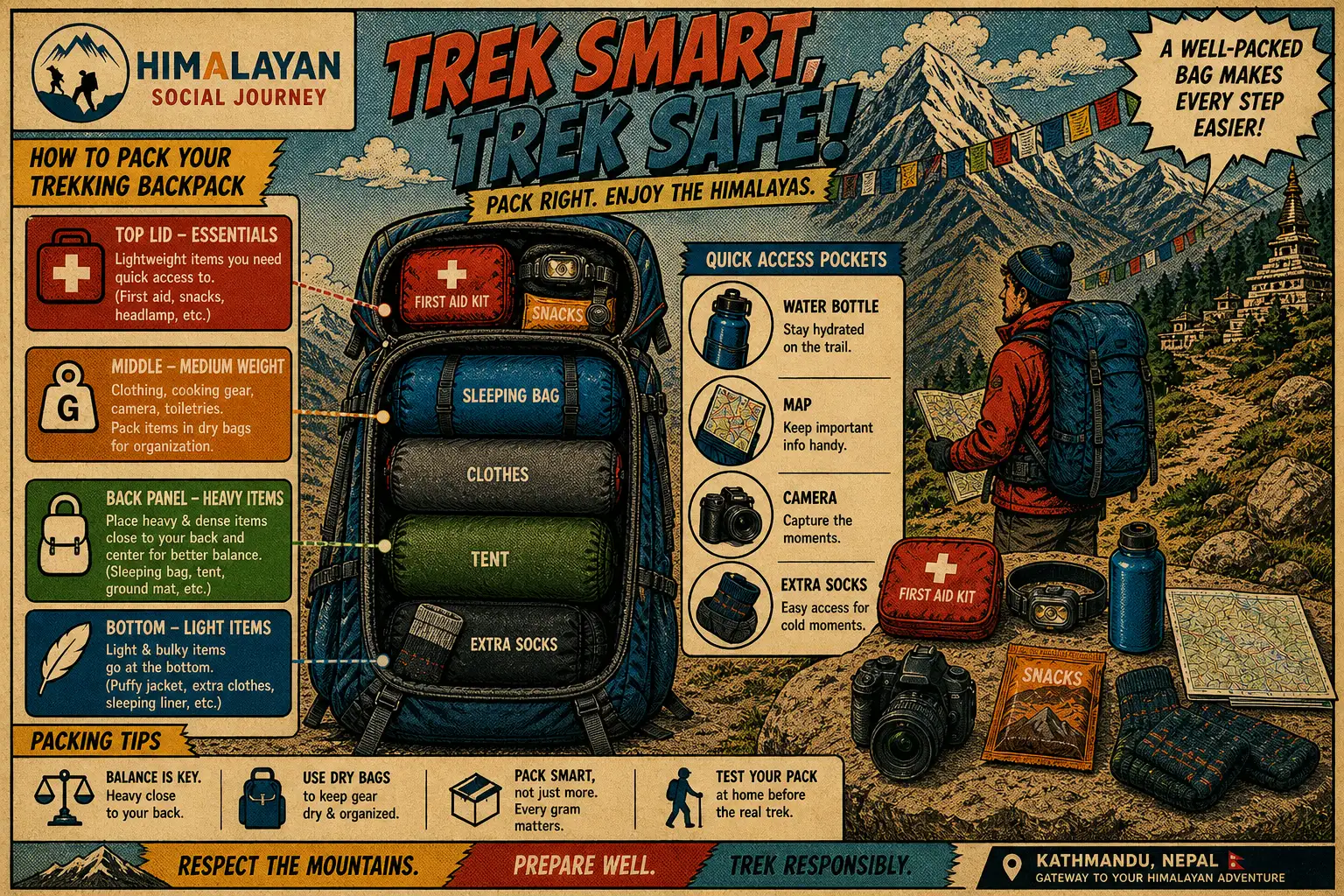
Weight distribution. Heavy items (water, food, stove) sit close to your spine and at mid-back height. Heavy at the bottom drags you backwards; heavy up top tips you forward. Both wreck your balance on screen and rocky steps.
Layered access. Things you need on the move (rain shell, snacks, sunscreen, headlamp) go in the brain (top lid) or hip belt pockets. Things you only need at camp (sleeping bag, base layers, toiletries) go at the bottom.
Wet-dry separation. Use dry bags or thick zip-locks. Sleeping bag in one. Spare clothes in another. Electronics in a third. A wet sleeping bag at 4,000m is dangerous, not just inconvenient.
Compression and balance. Tighten compression straps so the load doesn't shift mid-stride. Test the pack with full weight before you fly; a wobble in MacRitchie becomes a fall on a switchback.
Trekking Gear Singapore: The Categorised List
Singaporeans tend to over-pack tropical kit and under-pack alpine. The blind spot is cold-weather gear because we never need it at home.
Shelter and Sleep
If your trek is teahouse-supported (EBC, Annapurna, Kilimanjaro lodges), you don't need a tent. You will need a sleeping bag rated to roughly -10°C comfort for high-altitude nights, plus a silk or fleece liner. Teahouse blankets are unreliable. Add an inflatable pillow or stuff a jacket into a sack.
Clothing Layers The Tropical Trekker's Weak Spot
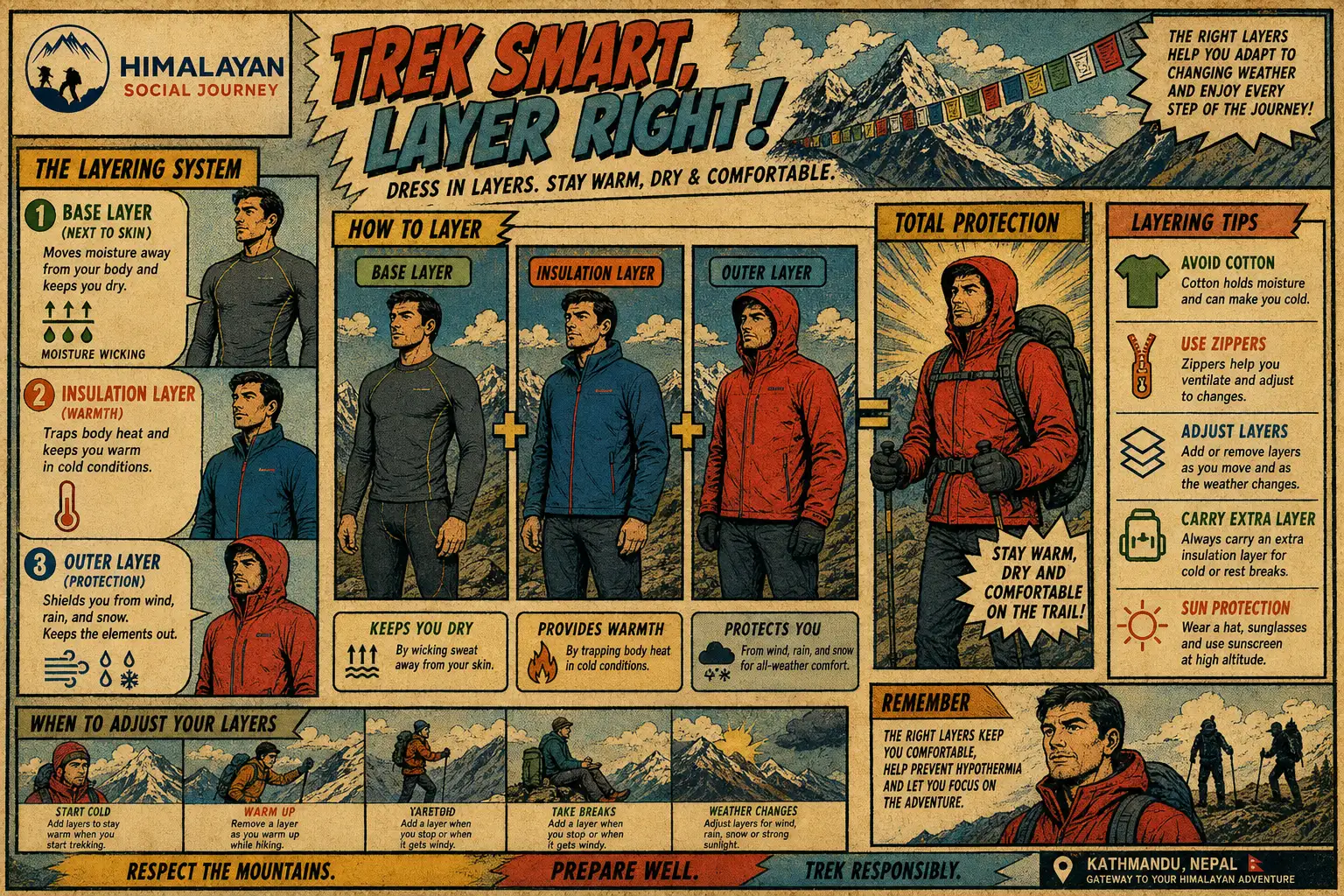
Build a system, not a wardrobe:
Base layer (top and bottom): merino wool or synthetic. Two sets — one to wear, one to dry.
Mid layer: fleece or light synthetic puffy.
Insulation: a proper down jacket, 600+ fill power. Non-negotiable above 4,000m.
Shell: waterproof and windproof jacket and pants. Gore-Tex or equivalent.
Extremities: beanie, buff, liner gloves, insulated gloves, two or three pairs of merino socks.
Sun protection: wide-brim hat, polarised sunglasses. UV is brutal at altitude.
Footwear
Stiff-soled, ankle-supporting trekking boots, broken in over at least 50 km of walking before you fly. New boots on day one is the fastest way to ruin your trip. Pair with merino hiking socks and gaiters if you'll be in mud, snow, or scree.
Navigation, Safety, Hydration, Food
Headlamp with spare batteries — cold drains them fast
Map, basic compass, offline GPS app (Maps.me, Gaia)
First aid kit with blister care, tape, ibuprofen
Diamox if your travel doctor approves it
2–3L hydration capacity, with a bottle as backup since bladders freeze
High-calorie snacks: nuts, dried fruit, energy bars, electrolyte sachets
Water purification: tablets or a filter
A detailed Mt Kinabalu packing list or Everest Base Camp gear Singapore checklist follows the same principles — adjust insulation for the maximum altitude and expected season.
Training for High Altitude Trek Singapore Style
Singapore's geography is not your friend. The highest natural point is Bukit Timah Hill at 163m. You can't train altitude — you can only train fitness. Here's how to train for trekking in Singapore properly.
Build a Z2 Cardio Base
Spend eight to twelve weeks before your trek doing three to four sessions per week of Zone 2 cardio (a pace where you can hold a conversation). Run easy, cycle, swim, row. Aim for 45 to 90 minutes per session. This grows the aerobic engine that altitude will tax.
Bukit Timah Hill Repeats
Hike up and down Bukit Timah's main trail with a weighted pack. Start with 6–8kg, build to 12–14kg over six weeks. Do four to six repeats. The grade is short, but the heat trains the same heart-rate response you'll need on long climbs.
MacRitchie Loop with Weighted Pack
The 11km TreeTop loop is your long-day rehearsal. Do it monthly with a fully loaded pack. If you can finish it comfortably at 12kg, you're trek-ready aerobically.
HDB Staircase Intervals
Find a 15- to 20-storey block with stairwell access and grace from your neighbours. Climb up and down with a pack. Six to ten sets, 60 to 90 seconds rest. Brutal, effective, free.
Stairmaster and Treadmill Incline
Most Singapore gyms have a stairmaster. Sessions of 30 to 45 minutes at moderate pace with a 6–10kg pack mimic alpine grade better than any flat surface. A treadmill at 10–12% incline is the alternative.
The Acclimatisation Reality Check
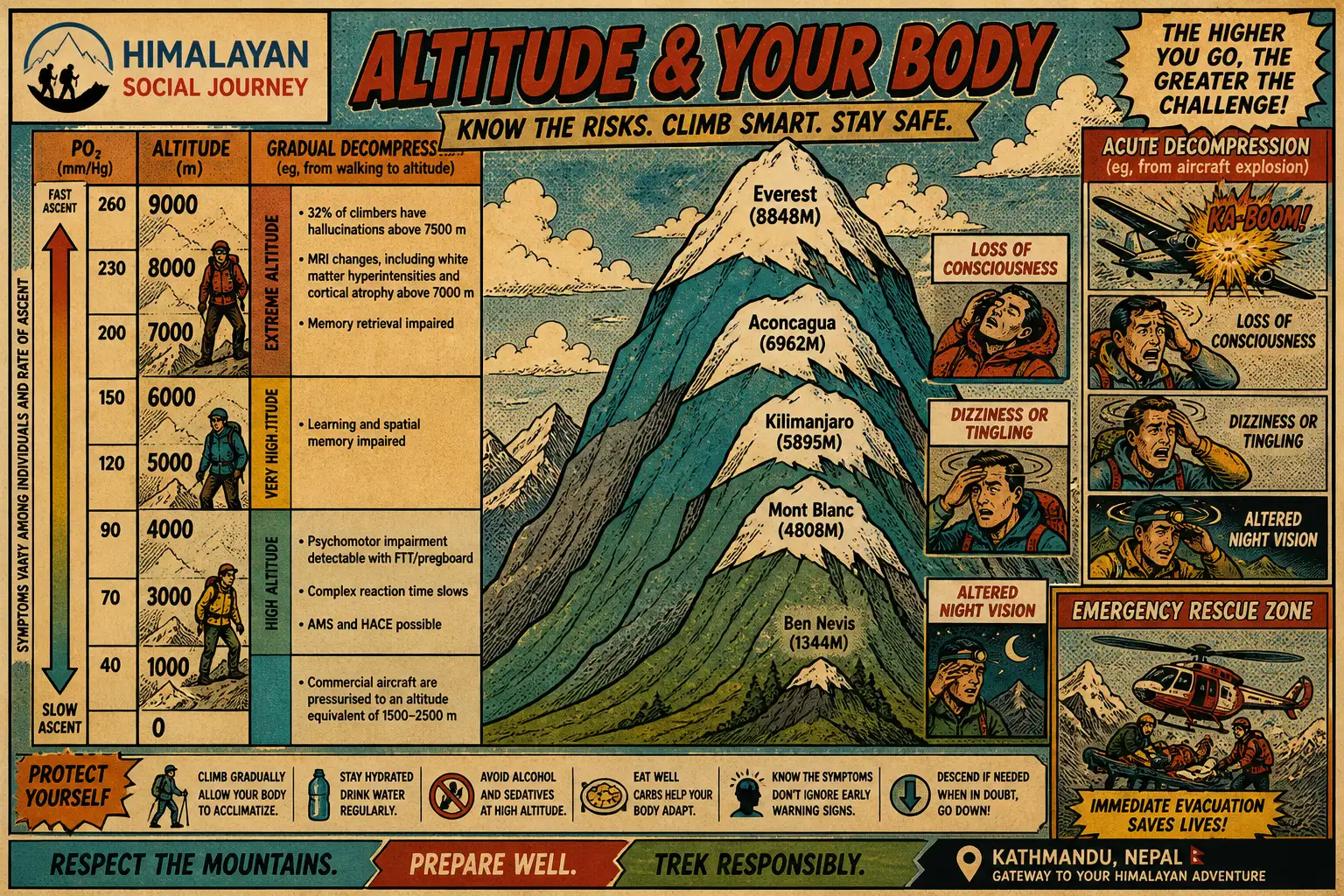
You live at sea level. Your body has no high-altitude red blood cells stored up. Most altitude sickness on EBC, Kilimanjaro, and Rinjani happens to fit people who pushed too high too fast.
Rules that travel well:
Above 3,000m, gain no more than 300–500m of sleeping altitude per day
Climb high, sleep low when you can
Stay hydrated 3 to 4 litres a day, less alcohol, less caffeine
Listen to headache, nausea, and breathlessness they're warnings, not weakness
Speak to a travel doctor about Diamox before you fly
Fitness helps you enjoy the trek. It does not protect you from altitude sickness. The two are unrelated.
Where to Buy Trekking Gear in Singapore
Several well-established outdoor retailers stock proper alpine kits. Visit in person fit matters more than online reviews.
Decathlon is the budget-to-mid-range workhorse. Their Forclaz and Quechua lines cover most beginner needs at fair prices.
Outdoor Life has been a fixture for serious trekkers and stocks technical brands like Osprey, Deuter, and Arc'teryx.
Lafuma carries its own French outdoor range, strong on packs and shells.
Campers' Corner is another long-running specialist with good staff knowledge.
Try packs on with weight inside, not empty. Walk around the shop. If a staff member won't help you fit a pack properly, go elsewhere.
Pre-Trip Checklist
Two weeks out, run through this:
Pack weighed and trial-walked at full load (target: under 15% of body weight)
Boots broken in with 50+ km logged
Travel insurance covering trekking up to your maximum altitude
Permits, visas, vaccinations sorted
Diamox prescription if using
Headlamp tested, batteries fresh
Sleeping bag and down jacket compressed and tested
Offline maps downloaded
Cash in small denominations (USD for Nepal, IDR for Indonesia, MYR for Sabah)
Emergency contact card in pack lid
Frequently Asked Questions
How fit do I need to be for Everest Base Camp?
You should comfortably hike six to eight hours a day for around twelve consecutive days with a daypack, after months of cardio and hill training. Average walking pace is slow because of altitude, but the cumulative load is high.
What size backpack do I need for the Annapurna Circuit?
For a teahouse-supported trek with a porter, a 30–40L daypack is enough. If you're carrying everything yourself, look at 55–65L. The best backpack for Annapurna Circuit is the one that fits your torso properly, not the trendiest brand.
Can I train for high altitude in Singapore?
You can train fitness, not altitude. Bukit Timah hill repeats, weighted MacRitchie loops, HDB staircases, and stairmaster sessions get you aerobically ready. Altitude adaptation only happens once you're at elevation.
Do I need mountaineering boots or trekking boots for Mt Kinabalu?
Stiff-soled trekking boots with good ankle support are sufficient. The summit push uses fixed ropes but doesn't require crampons. A proper Mt Kinabalu packing list focuses on layered clothing, gloves, and a headlamp for the pre-dawn start.
How much does it cost to gear up from scratch in Singapore?
It varies widely. Decathlon-led builds keep costs lowest; technical-brand builds run several times higher. Borrow what you can for your first trek before investing in your own kit.
Final Thoughts on Backpacking for Trekking Singapore
The leap from MacRitchie to a 5,000m pass is real, but it's a leap thousands of Singaporeans make every year. Get the pack right, build the gear list around the cold and the wet, train consistently for three to six months, and respect the altitude. That's the whole game.
Start your shortlist this weekend. Try packs on. Book a trial hike with a loaded bag. The mountain doesn't care how busy your week was only that you arrived ready.